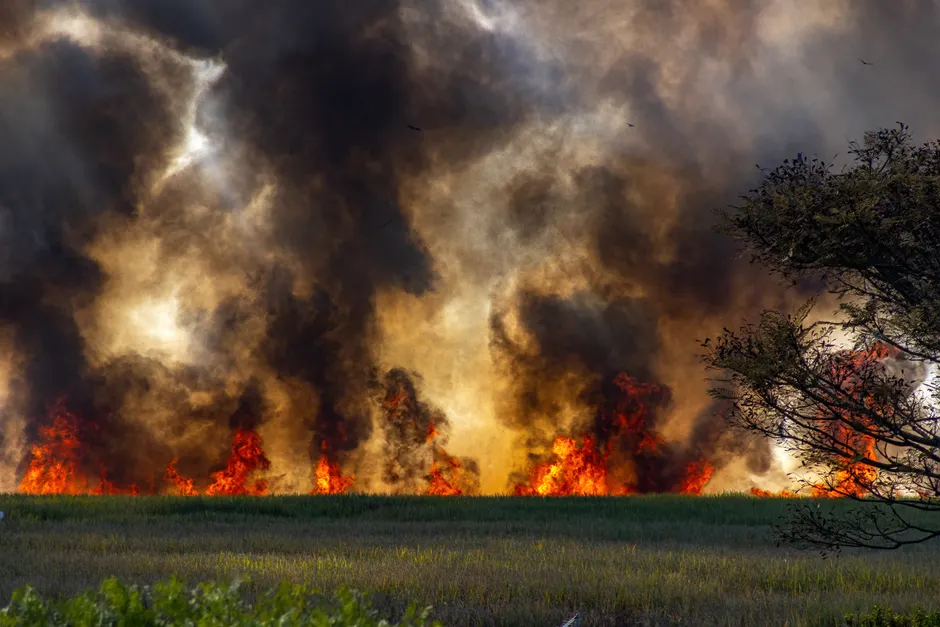
Wildfires Force 200,000 to Flee Across France and Spain as Heat Records Shatter

Over 200,000 people have been forced to flee wildfires burning across France and Spain as of July 25, 2026, with high winds hampering firefighting operations on both sides of the Pyrenees. Nampa The Independent
In France, 32 wildfires were active across the country as of Friday, July 24, with more than 50,000 hectares burned since the beginning of the year. French Interior Ministry The Fontainebleau forest in Seine-et-Marne, southeast of Paris, has been burning since July 12, a notable intrusion of large-scale wildfire activity into the Île-de-France region, well north of the Mediterranean and Atlantic corridors that typically bear the brunt of the summer fire season. French Gendarmerie
In Spain, the town of El Escorial, northwest of Madrid, is among the populated areas affected by active wildfires. Nampa Spanish Civil Protection had recorded four large wildfires exceeding 500 hectares as of July 5, below the decennial average of seven such events. Protección Civil Those four incidents occurred in Luena, Cantabria (February 27), Totana in the Región de Murcia (March 29), Ponteareas in Pontevedra, Galicia (April 6), and a separate blaze in Murcia. The relatively low count of large fires early in the season is cold comfort: the bulk of Spain's wildfire activity typically intensifies in July and August, and the current evacuation orders suggest the picture has shifted sharply.
The meteorological backdrop is unambiguous. June 2026 was the hottest June ever recorded in France. Météo-France A heatwave from June 17 to June 30 was described by Météo-France as precocious, durable, and very intense, producing a record minimum temperature of 27.2°C in Nantes, the highest nighttime low ever recorded there in any month. Météo-France Education Severe heat began to recede around mid-July, with Météo-France citing minimum temperatures of 27°C at Nîmes on July 9, 26.6°C at Avignon on July 6, and 25.9°C at Le Mans on July 13. Météo-France Education Météo-France's seasonal outlook for July through September pointed to more frequent anticyclonic blocking conditions as the most probable scenario, a weather pattern where a high-pressure system parks itself over a region, trapping dry, stable air and compounding fire risk. Météo-France
In Spain, AEMET's seasonal prediction for July through September 2026 indicated a very high probability that mean temperatures would fall in the warm tercile across the entire country, with southwestern Spain highlighted for particularly elevated probabilities. AEMET Observed data from AEMET in July recorded a maximum of 35.7°C and minimum of 25.8°C in the Comunidad Valenciana. AEMET
France's institutional firefighting campaign officially opened on June 4, 2026, building on the previous year's inauguration in Libourne. French Interior Ministry The fleet includes four additional Canadair amphibious firefighting aircraft acquired in 2022, augmenting the national aerial response capacity. French Interior Ministry Spain's institutional framework for wildfire tracking spans multiple agencies: MITECO published an advance wildfire report covering January 1 through July 12, while Protección Civil issued monitoring reports dated July 5 and July 12 and published its annual 2025 wildfire report on March 17, 2026. MITECO Protección Civil
The broader context here is one of compounding meteorological stress on firefighting infrastructure stretched across two of the EU's largest territorial expanses. The anticyclonic blocking pattern that Météo-France identifies as the dominant July-through-September scenario is the same atmospheric configuration that, in previous years, has enabled fires to sustain themselves overnight and reactivate along multiple fronts, rendering containment lines fragile. Think of it as a lid on a pot: the high-pressure system traps hot air underneath, preventing the cooling rains and wind shifts that would normally help firefighters gain ground. The Fontainebleau fire's latitude is a signal worth noting: when wildfire activity reaches the forests of Seine-et-Marne in mid-July, the geographic envelope of acute risk has expanded beyond the Mediterranean-Atlantic arc that French campaign planning has traditionally prioritized. The simultaneous activation of large-scale evacuation orders in both countries, under high-wind conditions that ground aerial assets at critical moments, suggests that the 50,000-hectare figure for France as of late July is a moving target rather than a settled account.
What remains uncertain is how the Spanish large-fire count, which sat below the decennial average in early July, has evolved through the second half of the month. The evacuation figures from both countries point to a rapid escalation that the July 12 monitoring reports from Protección Civil likely do not fully capture. With AEMET's warm-tercile probability spanning all of Spain through September and Météo-France's blocking-condition outlook extending across the same trimester, the meteorological window for further fire activity remains wide open.