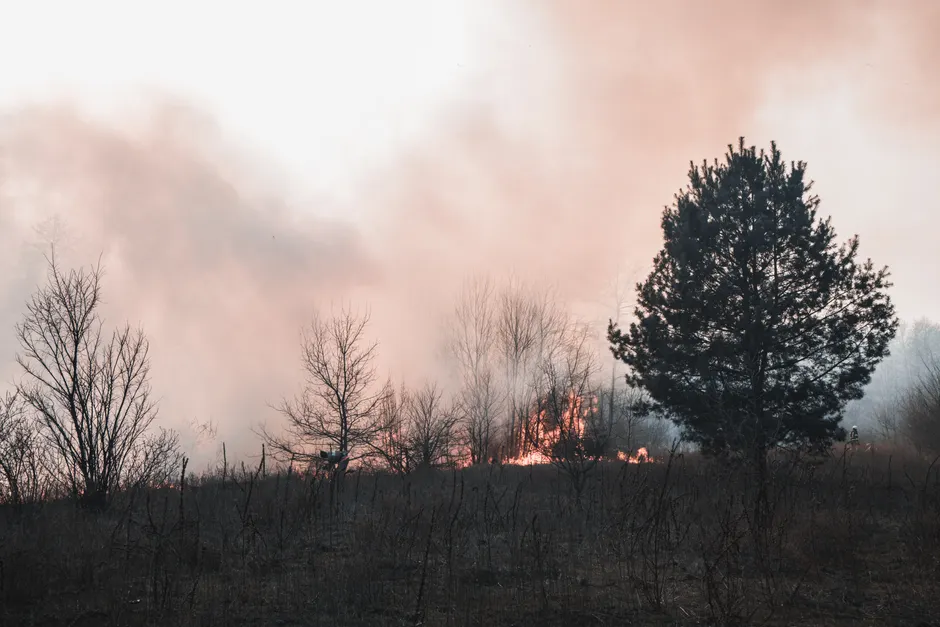
Wildfires and Heatwaves Push France and Spain to the Limit

Hundreds of thousands of people have been forced from their homes across Spain and France as wildfires, fueled by one heatwave after another, scorched vast tracts of land from the forests of Fontainebleau to the plains of Castellón by late July 2026 (NPR).
In France, roughly 220,000 people had been evacuated as of July 26, with fires threatening the Bordeaux area and burning across the Gironde and Landes regions (Reuters). President Emmanuel Macron said on July 27 that the fires in Landes were "contained" — meaning firefighters had established control lines around the blaze — and those in Gironde were "stabilized," meaning the fire was no longer spreading aggressively but not yet fully under control (CNN). That stabilization came at a steep cost: two firefighters died on July 21 around 2:30 PM while battling wildfires in Gironde (Gendarmerie nationale).
The crisis reached the Paris region as well. A large wildfire tore through the Fontainebleau forest in Seine-et-Marne starting July 12, burning about 10% of the historic forest (Gendarmerie nationale; French Interior Ministry). French authorities warned that an intense heatwave would peak on July 29. That same day, Spain's Civil Protection and Emergencies agency issued an alert for the fourth heatwave of the summer, also starting July 29 and expected to last until August 2, according to French authorities cited by CNN (CNN).
The scale of destruction in Spain is visible in the numbers. As of July 5, about 50,751 hectares of forest had burned. By July 27, Prime Minister Pedro Sánchez announced from an advanced command post in Castellón that over 170,000 hectares had burned across Spain — six times more than in the same period the previous year (Spanish Presidency; Protección Civil). More than 75,000 people had been evacuated in Spain, with an additional 30,000 ordered to evacuate as of July 26 (Reuters).
The fires began early in the month and spread rapidly. On July 1, a wildfire in Santa Elena (Jaén) forced the evacuation of 190 people, and a separate blaze in Yeste-Molinicos (Albacete) disrupted a power line. Between July 6 and 9, nine wildfires broke out in Catalonia (Protección Civil). Sánchez visited the fire in La Mierla, Guadalajara, on July 22, then toured advanced command posts in Navaluenga on July 26 and Castellón on July 27, a schedule that shows how widely the emergency stretched across Spain's autonomous communities — regional governments with their own administrative powers (Spanish Presidency).
On July 28, the Spanish government activated wildfire aid and approved extraordinary labor protections for affected populations. It also declared 211 zones across 14 autonomous communities as affected by civil protection emergencies (La Moncloa; Protección Civil). This declaration, which Sánchez had previewed from Navaluenga, triggers access to emergency funds and tax relief for the affected municipalities. That same day, Spanish authorities allowed residents to return to 13 municipalities as emergency measures were scaled back (Reuters.
France, for its part, had moved preemptively. The Interior Ministry launched a 2026 wildfire and vegetation fire prevention campaign on June 9, targeting both French citizens and foreign tourists. On July 24, it published an ORSEC "Extreme Heat" guide as part of a broader framework to improve prevention, firefighting, and post-fire reconstruction (French Interior Ministry; French Interior Ministry). The ORSEC guide is a component of France's civil security planning — essentially a playbook that coordinates how different government agencies respond together under extreme heat conditions.
The two countries' responses reveal different institutional approaches to the same problem. Spain has leaned on rapid emergency declarations and labor protections to manage the social fallout, while France has emphasized preventive planning and public awareness campaigns. Both are now being tested by the same meteorological driver: a fourth heatwave expected to begin July 29 and, in Spain's case, persist through August 2. With fires in Landes contained but Gironde only stabilized, and with Spanish authorities beginning to scale back evacuations even as a new heatwave looms, the coming days will determine whether the current containment lines hold or whether the summer's destruction accelerates further.
The broader context here is that the sixfold increase in burned area in Spain year-over-year, reported by Sánchez himself from a command post rather than a press room, fits a pattern European fire agencies have been tracking for several seasons. The question facing policymakers is no longer whether the wildfire threat is intensifying, but whether the institutional tools — from ORSEC guides to zona afectada declarations — can keep pace with how quickly that threat is evolving.