Europe's Summer of Extremes: What the Record Heat and Wildfires Tell Us

Record heat and wildfires are devastating Europe this summer, with scientists warning that the climate crisis is accelerating rather than stabilizing, according to a New York Times report published July 29, 2026 (NYT).
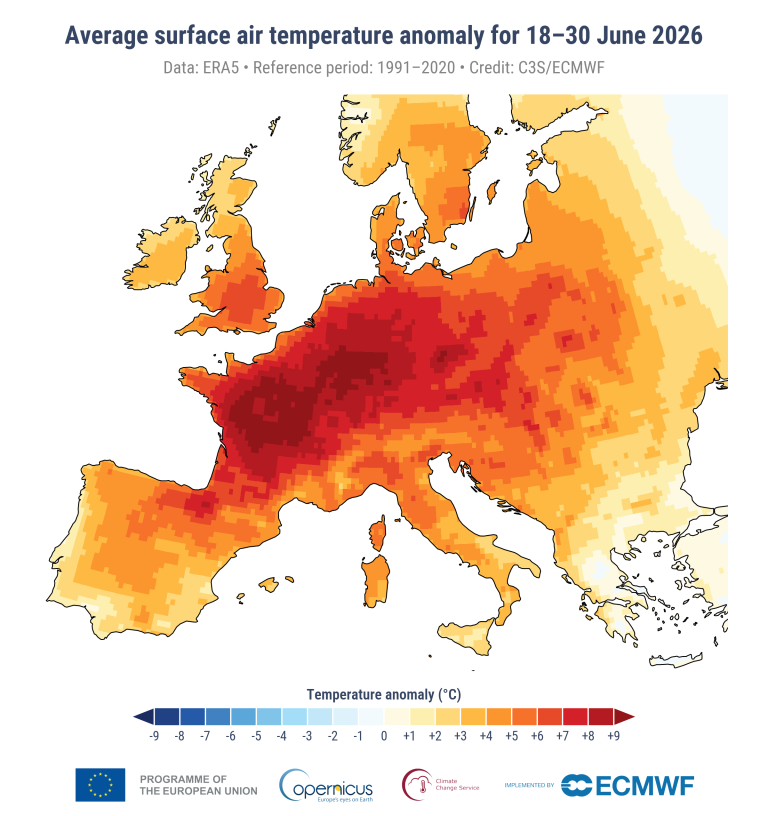
The data behind that assessment has been building for months. In June 2026, the average temperature over European land reached 19.14°C, which was 1.78°C above the 1991–2020 reference period used by scientists as a baseline for comparison (Copernicus). June 2026 ranked as the second-warmest June on record for European land temperatures and the second-warmest June globally, according to the World Meteorological Organization (WMO). For western Europe specifically, it was the hottest June on record (WMO).
The summer's extremes did not begin in June. Western Europe experienced an unusually early and intense heatwave during the second half of May 2026, concentrated between 21 and 30 May, according to Copernicus monitoring (Copernicus). That event fed into June, when much of the continent was hit by a further intense heatwave that drove record monthly temperatures across the western part of the region (Copernicus).
Western Europe's June heat was amplified by the highest sea surface temperatures on record for the time of year, the WMO reported (WMO). Normally, ocean breezes help cool coastal Europe. But when sea surface temperatures are unusually high, that natural cooling effect weakens, allowing heat over the land to build more aggressively — think of it like a fan blowing warm air instead of cool air.
A further factor may be entering the picture. In June 2026, the WMO indicated an 80% likelihood of an El Niño event developing during the June–August 2026 window (WMO). El Niño is a periodic warming of the central and eastern equatorial Pacific Ocean that tends to add a layer of additional global warmth on top of the long-term warming trend caused by human greenhouse gas emissions. Reuters reported that the WMO warned the combination of climate change and El Niño could make 2027 the hottest year since records began (Reuters.
The broader context here matters for anyone tracking climate risk. The sequence now unfolding — an early-season heatwave in May, followed by record-setting June temperatures and widespread wildfires in July — aligns with the pattern that attribution science (the field that links specific weather events to climate change) has been projecting for years. Higher baseline temperatures from accumulated greenhouse gases produce more frequent, more intense, and earlier-season extremes. What stands out in the current data is not novelty but convergence. The land-temperature anomaly, the record sea surface temperatures, and the El Niño forecast are all reinforcing one another at the same time. That simultaneous overlap compresses the gap between hazard events and shrinks the recovery window for ecosystems, infrastructure, and emergency response systems.
The WMO's 80% El Niño probability introduces a forward-looking dimension that extends beyond the current European summer. If El Niño develops and persists, its peak global temperature effect would typically appear in the year following its onset, which is consistent with the WMO's warning that 2027 could set a new global record. For governments and international institutions, that means the current crisis cycle is unlikely to be a one-off. It is more likely a preview of a higher baseline. Adaptation planning based on past climate normals — including the 1991–2020 reference period already exceeded by 1.78°C over European land in June — will continue to underestimate how severe and how frequent these compounding extremes will be. Emergency response capacity, agricultural resilience, and energy-grid load planning all face stress tests that current infrastructure thresholds may not withstand.
The NYT report frames the situation as a breaking point. The data from Copernicus and the WMO, published independently and across different timescales, provides the quantitative backbone for that characterization. What is unresolved is whether the political response across European capitals will calibrate to the trajectory the science is describing or continue to lag behind it.