Autonomous's $9 NFC Key Physically Locks Your Distracting Apps — Now Shipping in Beta
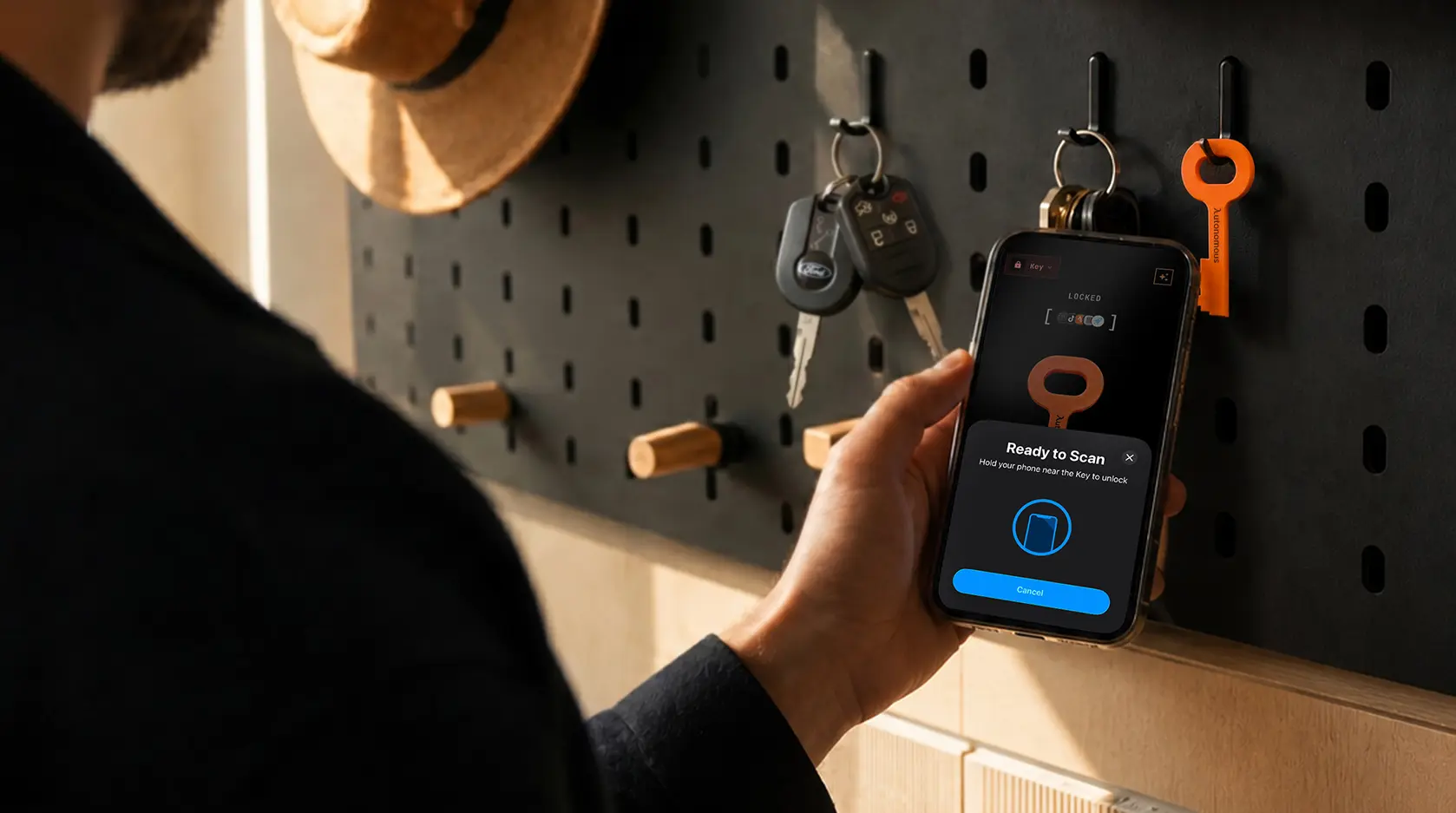
Autonomous, best known for office furniture and smart workspace products, has started shipping a $9 NFC key that physically locks away apps you choose to restrict on your phone. The device, called the Autonomous Key, pairs with a companion app and began reaching Kickstarter backers in July 2026. It is currently in beta.
The key itself is an NFC tag — a small chip that communicates with your phone when tapped against it — roughly three inches long, available in pink, orange, blue, gray, and brown. To unlock restricted apps, you tap the key on your phone. Each unlock session lasts up to 60 minutes, after which the apps lock again automatically. No subscription or premium tier is required, and one key can pair with multiple phones.
Compatibility covers Android 8.0+ and iOS 15+, which together account for the overwhelming majority of active devices on both platforms. The companion app also offers AI-powered insights: it tracks how often you unlock restricted apps, how long they stay accessible, and the times of day you're most likely to reach for them. TechCrunch
At $9, the Autonomous Key undercuts the existing field of physical distraction-management devices considerably. Competitors include Blok at $29, Unpluq at $26.50, and Brick at $59. None of those come close to the Autonomous Key's price, and Autonomous has also opted to skip the recurring subscription model that some digital wellness tools use for revenue. TechCrunch
The product does have a notable rough edge in its current beta state. If you lose the key while your apps are locked, the only workaround is to uninstall and reinstall the companion app. The company says it is developing a backup unlock method for a future update, but until that ships, a lost key means a fairly cumbersome recovery process. For a device designed to reduce friction in the opposite direction — getting you to put your phone down — the irony of the recovery path is worth noting, though it is a known limitation of a beta product rather than a design flaw.
The broader context here is a small but growing hardware category built around a simple premise: willpower is a scarce resource, and a physical token can enforce a boundary that a software toggle alone cannot. The reasoning draws on what behavioral researchers call "commitment devices" — mechanisms that impose a cost on future actions to align them with present intentions. A phone setting you can reverse in two taps is a weak commitment device. A key you left in another room is a stronger one.
Whether NFC tags are the right technology for that enforcement is a separate question. The approach has clear advantages: NFC keys are cheap, require no battery, and work across both major mobile platforms through well-supported APIs. The disadvantages are equally clear: keys can be lost, the 60-minute session model is rigid compared to software-based approaches like iOS Screen Time or Android Digital Wellbeing, and the uninstall-and-reinstall recovery path is a failure mode that software-only solutions do not share.
The AI-powered insights layer is the element most likely to differentiate the Autonomous Key from a plain NFC tag a user could program themselves. Tracking unlock frequency, session duration, and time-of-day patterns gives users behavioral data that the native Screen Time and Digital Wellbeing dashboards present differently or not at all. Whether those insights are actionable enough to justify the additional hardware, or whether they mainly add a layer of analytics polish to what is fundamentally a tap-to-unlock workflow, will depend on implementation details that the beta may still be refining.
The $9 price point is the factor most likely to broaden the audience for this category. At Blok or Brick pricing, physical app-locking devices appeal to a self-selecting group motivated enough to spend $30 to $60 on a willpower aid. At $9, the purchase decision shifts closer to an impulse buy, and the no-subscription model removes the ongoing cost objection that may deter users already skeptical of adding another recurring line item to manage their phone habits.
The product is shipping now in beta, with the company working on the backup unlock method as its most pressing known gap. Five color options, multi-phone pairing, and broad OS support round out a feature set that is, at this price, difficult to fault on paper. The open questions are operational: how reliable the NFC pairing proves over time, how quickly the backup unlock ships, and whether the AI insights layer delivers value beyond what users already get from their operating system's built-in wellness tools.