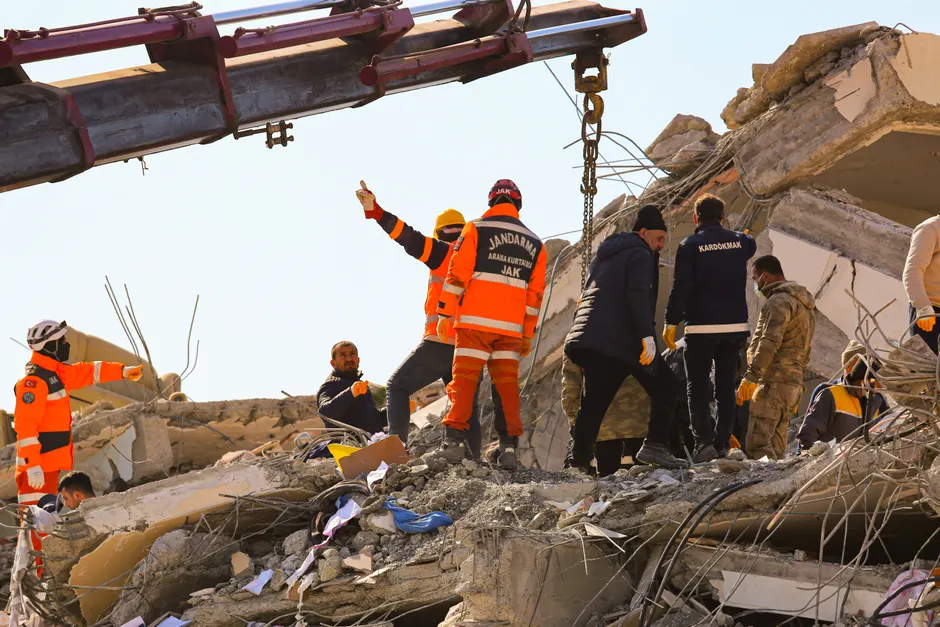
Venezuela Doublet Earthquakes Kill at Least 164, Collapse Buildings in Caracas

Two major earthquakes struck northwestern and central Venezuela on June 24, 2026, killing at least 164 people and injuring 971 more, according to acting President Delcy Rodríguez as reported by AP News. The USGS recorded the sequence as a doublet — two closely coupled mainshocks rather than a foreshock-mainshock or mainshock-aftershock pair — with the first event measuring M7.2 and the second M7.5, separated by just 39 seconds.
Both events were centered southeast of Yumare, in Yaracuy state, at depths of 23 km and 28 km respectively. The USGS attributes the mechanism to strike-slip faulting along a complex plate boundary — the zone where the South American and Caribbean plates grind past one another in a predominantly east-west sense. That boundary has generated destructive earthquakes before; the 1812 Caracas earthquake and the 1900 Mw 7.7 event offshore are part of the same structural setting. Strike-slip ruptures at these depths tend to produce strong, broadly felt shaking rather than the tsunami risk associated with shallow subduction, but their proximity to densely populated urban centers converts seismic energy efficiently into casualties and structural damage.
The doublet classification is seismologically significant. True doublet sequences — where two events of comparable magnitude rupture adjacent or overlapping fault segments within seconds of each other — are relatively rare and can complicate both immediate damage assessment and aftershock forecasting. Standard Omori-law aftershock models are calibrated for a single mainshock; a doublet effectively resets and compounds the stress field, meaning the decay rate and spatial distribution of subsequent seismicity is harder to constrain in the hours and days that follow.
Buildings collapsed in Caracas, roughly 250 km east of the epicentral zone, underlining the long-period energy content typical of large strike-slip ruptures. Caracas sits in a valley whose sedimentary fill is prone to basin amplification — a well-documented vulnerability that contributed to severe damage in the 1967 M6.5 Caracas earthquake. The degree to which informal or unreinforced masonry construction in the capital explains the collapse toll will be a key question for post-event engineering surveys.
The humanitarian picture is still developing. A death toll of 164 with nearly a thousand confirmed injuries, reported within roughly 24 hours of the mainshock, typically represents a floor rather than a ceiling: search-and-rescue operations in collapsed structures routinely add to the count over the first 72 hours, and hospitals in Venezuela have been operating under severe resource constraints for years. The country's weakened infrastructure — power, communications, and health systems — will shape the recovery trajectory as much as the physical damage itself.
Rodríguez, who holds the acting presidency following the contested political situation that has defined Venezuelan governance in recent years, is now the face of the government's disaster response. How Caracas manages international aid offers — and whether the Maduro government's strained relationships with Western donors and regional neighbors complicate the logistics of relief — will bear watching closely in the coming days.
For seismic risk analysts and emergency managers in the region, the event is a pointed reminder that the Caribbean–South American plate boundary remains one of the more hazardous and relatively under-instrumented tectonic zones in the Western Hemisphere. Regional early warning infrastructure and building code enforcement in Venezuelan cities have lagged behind comparable urban centers in earthquake-prone Latin American nations. The doublet's rapid succession — two M7+ ruptures in under a minute — is the kind of scenario that stress-tests response systems designed around single-event assumptions.