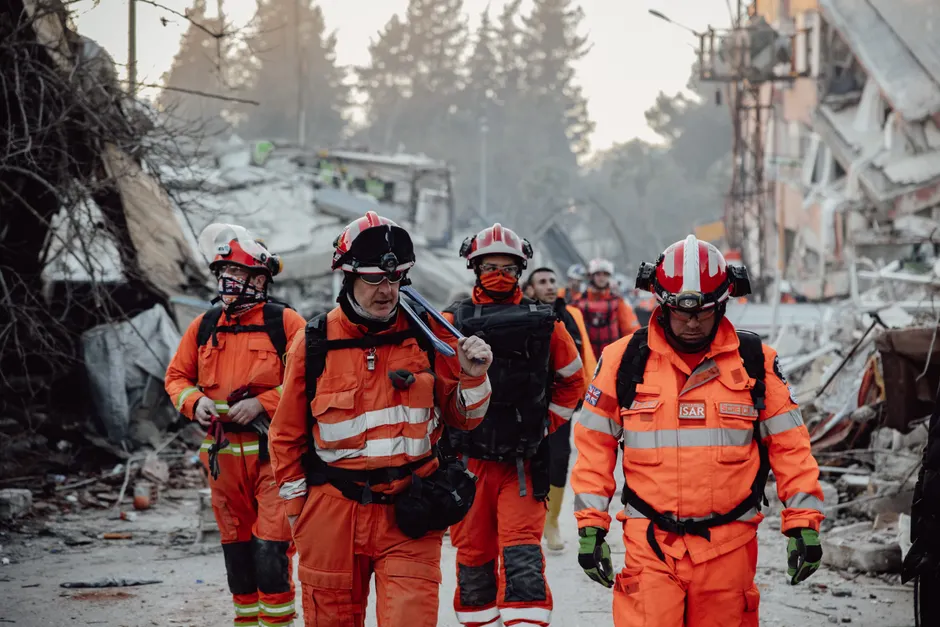
Twin Major Earthquakes Strike Venezuela, Killing at Least 188

Two powerful earthquakes struck Venezuela in rapid succession on June 24–25, 2026, leaving at least 188 people dead and more than 1,520 injured, with hundreds still unaccounted for. The first tremor registered magnitude 7.2, centered roughly 160 km west of Caracas; within less than a minute, a magnitude 7.5 followed along the same zone — a sequential rupture sequence that dramatically amplified structural damage across the region, according to Reuters.
The coastal state of La Guaira, which sits between the capital and the Caribbean Sea along a narrow coastal shelf, bore the heaviest toll. Buildings collapsed across its densely packed neighborhoods, and AP reported that casualties there were among the most severe documented anywhere in the affected zone. La Guaira's geography compounds seismic risk: its urban fabric is compressed between steep Ávila mountain slopes and the sea, leaving little lateral margin when ground motion is this intense.
The casualty figures as of June 25, 2026 — 188 confirmed dead, over 1,520 injured — should be understood as provisional. In sequential seismic events of this magnitude, rescue operations are phased: the first hours are dominated by extrication from surface collapse, while deeper structural pancaking and landslide debris fields yield additional casualties over subsequent days. The number of missing persons, reported by AP without a precise figure, is the variable that carries the most uncertainty at this stage.
Seismic Context
Venezuela's seismic exposure is well-established but chronically underappreciated relative to other Latin American fault systems. The country sits on the boundary between the South American Plate and the Caribbean Plate — a complex transpressional margin characterized by oblique strike-slip and compressional faulting. The El Pilar and Boconó fault systems have historically generated destructive events; the 1812 Caracas earthquake and the 1997 Cariaco earthquake (M6.9) are benchmarks in the regional record.
A magnitude 7.5 event is significant by any measure on this margin. The sub-minute interval between the two tremors is consistent with either a foreshock-mainshock sequence or a closely spaced doublet rupture on adjacent fault segments — a distinction that affects both aftershock modeling and the engineering assessment of cumulative structural damage. Buildings weakened by the first event are structurally degraded when the second, larger one arrives, which explains disproportionate collapse rates even in structures that nominally met code tolerances.
Response and Access Constraints
Venezuela's humanitarian response capacity has been severely diminished by years of economic contraction, infrastructure decay, and the attrition of technical institutions. Emergency response in a country where fuel, heavy equipment, and medical supplies are chronically scarce is qualitatively different from a comparable event in a country with functional logistics chains. International offers of aid — and the political conditions under which the Maduro government accepts or declines them — will bear close watching in the coming 48 to 72 hours.
La Guaira is also home to Venezuela's main international airport, Simón Bolívar International. Runway and terminal integrity at this point remains unconfirmed in verified reporting, but if the facility has sustained structural damage, it would constrain the speed and volume of incoming relief flights — a logistical chokepoint with immediate humanitarian consequences.
Al Jazeera's live coverage placed the injury toll at 1,520 as of June 25, with the situation described as still evolving. The gap between that figure and the confirmed death count reflects both the pace of hospital intake and the ongoing nature of rescue operations across multiple affected municipalities.
What the coming days will clarify is the true scale of structural loss — not just the human toll, but the inventory of housing, public infrastructure, and utilities rendered unusable. In contexts with pre-existing poverty and housing precarity, earthquake displacement tends to outlast the immediate emergency by months or years. Venezuela's combination of seismic exposure, degraded building stock, and constrained state capacity puts it at the difficult end of that spectrum.