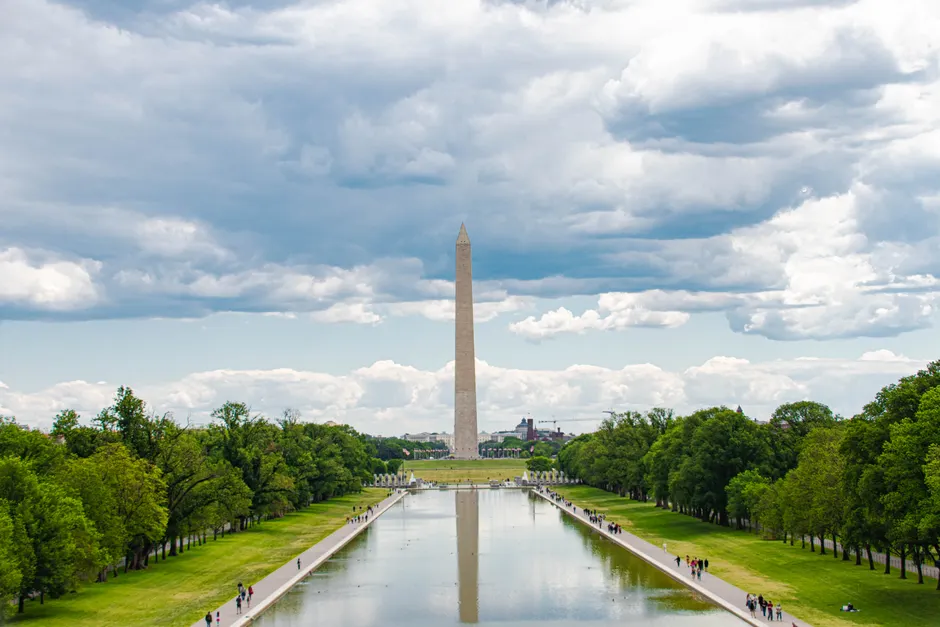
Lincoln Memorial Reflecting Pool Drained Again Amid Vandalism Dispute and Cost Overruns

Crews began draining the Lincoln Memorial reflecting pool on Friday, July 10, in the second such operation since a $14.7 million no-bid renovation was completed earlier this year The Guardian. The move follows public remarks by Interior Secretary Doug Burgum, whose department oversees the National Park Service, that another draining was imminent to remove debris left by an extensive Independence Day fireworks display over the National Mall.
Burgum previewed the work in an interview with podcaster Katie Miller — wife of deputy White House chief of staff Stephen Miller — released earlier in the week of July 6 The Guardian. His instructions, as quoted: "Drain the water, clean up the fireworks stuff. Repair the vandalism that was done. Fill it back up again." On CNN's State of the Union days earlier, Burgum had suggested a partial draining might suffice CNN. The full draining observed Friday indicates that calculus shifted, or that the fireworks residue proved more extensive than initially assessed.
The reflecting pool, built around 1922 and now 104 years old, had already been closed to the public from April 10 through June 10 for the renovation itself NPS, then subject to intermittent closures between June 28 and July 9 for the erection and removal of anti-scale fencing NPS. It was shut again for the July 4 celebration itself. The frequency of closures on a monument meant to be perpetually visible to tourists and the public has become, in its own right, part of the story.
President Trump has framed the pool's condition as a legacy failure, calling it "filthy dirty" and attributing neglect to the Biden administration. He pursued a specific aesthetic outcome: the liner coating was painted in the hue of the American flag, an explicit attempt to render the reflecting pool a patriotic symbol rather than a simple architectural water feature. The renovation's cost has since climbed. Reuters reported the underlying contract at $14.7 million in June Reuters; by the Guardian's more recent accounting, the estimated total renovation cost now exceeds $16 million The Guardian.
That cost growth tracks a familiar pattern in the project: algae blooms turned the water green-ish, and the blue liner began peeling within weeks of completion — the Reuters headline from June 18 noted paint already flaking. The administration's public response has been to attribute the deterioration to vandalism rather than materials failure or workmanship. The National Park Service reported a June 9 incident to police in which a sharp knife or razor allegedly cut the new liner. Separately, former Olympic cyclist David Hearn was indicted on a felony property-destruction charge tied to the pool and pleaded not guilty The Guardian. Hearn has said he reached into the pool to examine peeled sealant and released a chunk of it only when a park worker told him to do so. His attorneys issued a pointed statement: "This indictment reflects the administration's effort to shift blame for their own failures. The justice system exists to determine facts, not to provide political cover."
The vandalism narrative and the felony prosecution sit uneasily beside the administration's stated confidence in its original contractor. Burgum told CNN the administration will not solicit competing bids for further repairs, saying it will "use the same company because they did a fantastic job" — a characterization that predates, or at least coexists with, the algae blooms and liner failures the company's initial work produced. That contractor, Ohio-based Green Water Solutions (also operating as Greenwater Services), received a separate $1.7 million contract to install a water-purification system in the pool. Reports have also surfaced of contractors on the broader overhaul having longstanding ties to Trump personally, prompting criticism that the selection process favored loyalty over competitive procurement.
The reflecting pool work is one piece of a larger set of physical alterations Trump has pursued in the capital. He has already demolished the White House East Wing to make way for a $400 million ballroom, and has proposed a triumphal arch spanning the ground between the Lincoln Memorial and Arlington National Cemetery. In May, Trump posted that the reflecting pool renovation would finish "prior to July 4th" and claimed the project was "ahead of schedule" — a claim the subsequent closures, draining, and cost overruns complicate, if not directly contradict.
What distinguishes this episode from an ordinary infrastructure hiccup is the symbolic freight the administration has attached to the site. A reflecting pool that mirrors the Lincoln Memorial's colonnade has functioned for a century as a backdrop for demonstrations, inaugurations, and national mourning; turning its liner into a flag motif and then prosecuting a bystander for touching peeling sealant folds partisan messaging into what has traditionally been treated as neutral federal parkland. Whether the no-bid, single-contractor approach produces a durable fix or another round of draining by autumn is, at this point, an open empirical question rather than a political one — though in Washington, the two rarely stay separated for long.