France Evacuates 40,000 from Cap Ferret as Dual Wildfires Scorch Gironde and Landes

French authorities ordered the progressive evacuation of the Cap Ferret peninsula on July 24, 2026, as a wildfire that began two days earlier near the village of Saumos consumed more than 10,000 hectares (24,700 acres) of forest and forced the displacement of 40,000 people. Interior Minister Laurent Nuñez confirmed the figures on Friday morning, with the Gironde blaze still unstabilised. The Guardian
The fire ignited on July 22 near Saumos, approximately 40 kilometres from Bordeaux, and progressed northwest toward Le Porge before bearing down on the Lège-Cap-Ferret peninsula. The Gironde prefecture triggered the FR-Alert emergency notification system to coordinate the evacuation of the peninsula's first villages, ordering a village-by-village withdrawal conducted either by sea or via the sole road connecting Cap Ferret to the mainland. Boats began ferrying residents and holidaymakers from four piers early on July 23. Gironde Prefecture
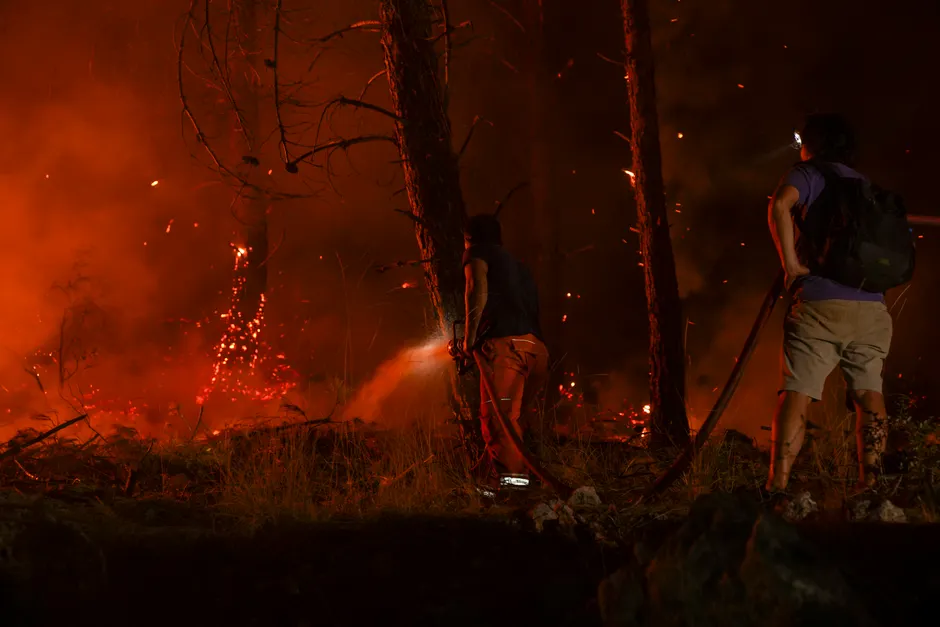
Roughly 800 firefighters and four water-bombing aircraft were deployed against the Gironde blaze north of Arcachon Bay. Flames reached heights of 10 metres, driven by strong winds across tinder-dry terrain. Eighty houses have been destroyed. The Gironde prefecture's 21h30 situation update on July 24 reported that preventive evacuations across the communes of Le Porge, Saumos, Le Temple, and Lège-Cap-Ferret concerned nearly 20,000 people. Earlier, 600 residents of the Le Porge Lauros neighbourhood had been redirected to Lège-Cap-Ferret. Gironde Prefecture
A second fire, burning near Biscarrosse in the neighbouring Landes department, has consumed more than 2,500 hectares and prompted the evacuation of approximately 23,000 people, according to Landes prefect Gilles Clavreul. More than 600 firefighters were deployed to that blaze. The Guardian
President Emmanuel Macron activated the EU civil protection mechanism, securing reinforcements from two Croatian aircraft, two Portuguese planes, and two heavy helicopters contributed by the Czech Republic and Slovakia. The cross-border mobilisation drew on a framework designed to pool aerial firefighting assets among member states during peak wildfire season. The Guardian
The logistics of the Cap Ferret evacuation are shaped by geography. The peninsula, a narrow spit of land separating the Atlantic from Arcachon Bay, is accessible by a single road. When fire threatens that corridor, maritime evacuation becomes a structural necessity, not a contingency. The deployment of boats from four piers underscores the redundancy authorities required to move tens of thousands of people under wind-driven fire conditions.
The Gironde and Landes departments are no strangers to large-scale wildfires, and the terrain, a mix of pine plantation and heathland, is combustible in dry, windy conditions. The simultaneous ignition of two major blazes in adjacent departments stretches French civil protection capacity and helps explain Macron's swift recourse to the EU mechanism. The reinforcements from Croatia, Portugal, the Czech Republic, and Slovakia represent the kind of aerial assets that France's own fleet cannot multiply on demand.
The figures bear watching. Nuñez's count of 40,000 people already or about to be evacuated, as of Friday morning, reflects a dynamic situation. The Gironde prefecture's 21h30 update on the same day cited nearly 20,000 for the preventive evacuations across the four communes. These are not necessarily contradictory figures; the prefectural update covers a specific set of communes, while the interior minister's figure likely encompasses the broader evacuation zone including populations already displaced or in the process of being moved. But the gap between the two numbers illustrates how rapidly the operational picture evolves during an unstabilised fire, and how different authorities at different levels of government can report overlapping but non-identical figures within hours of each other.
The destruction of 80 homes, while a subset of the broader acreage burned, marks the fire's transition from a forest event to one with direct civilian impact. With the blaze unstabilised and strong winds persisting, the final toll, in hectares, structures, and displaced persons, is not yet settled. The holiday-season timing compounds the evacuation challenge: Cap Ferret's population swells in summer, meaning the number of people on the peninsula at any given moment far exceeds its permanent residential base.
France's wildfire season in the Landes de Gascogne forest has produced episodes of comparable scale in recent years. The deployment of EU aerial assets reflects both the severity of the current blazes and the institutional pathway now routinely available to member states facing simultaneous domestic emergencies. Whether the EU reinforcements arrive in time to affect the containment trajectory of either blaze will depend on wind conditions and the rate of fire progression over the coming days.