US Disables Second Blockade-Runner in Strait of Hormuz as Saudi-Houthi Escalation Deepens

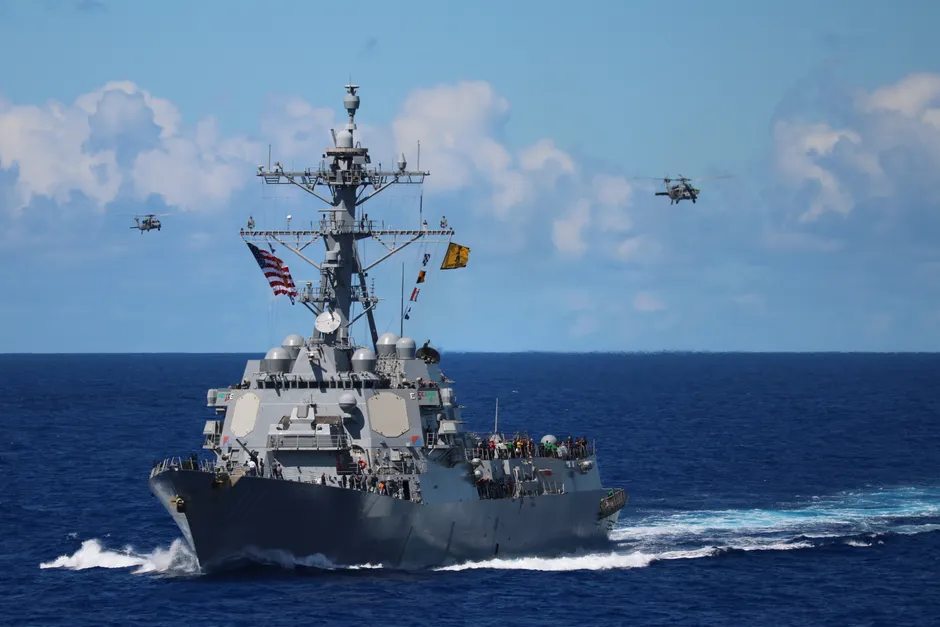
The US military disabled a commercial tanker in the Strait of Hormuz on July 25, 2026, after the vessel attempted to breach an American blockade on Iranian ports. Navy Captain Tim Hawkins, spokesman for US Central Command, stated that the ship's crew attempted to run the blockade at least four times before US forces fired into its engine room (BBC). The tanker, which was attempting to evade the blockade, is no longer transiting to Iran. The BBC report does not name the specific vessel, referring to it only as "a tanker ship" and "the second commercial ship the US has disabled since it reimposed its blockade."
Earlier reporting from July 24 confirmed the sequence. PBS NewsHour and ABC7 News both carried the story that the US military fired on another merchant vessel attempting to breach the blockade, describing it as the second commercial ship disabled since enforcement was reimposed (PBS; ABC7). A prior engagement reported by The Guardian on July 16 documented the US using Hellfire missiles to disable an unladen oil tanker in the same strait (The Guardian). A CENTCOM public release states that during the first 24 hours of enforcement, the command redirected two compliant commercial vessels and disabled one non-compliant vessel (CENTCOM).
The escalation is not confined to the Strait of Hormuz. The Houthis claimed a missile attack on the Saudi city of Jizan, causing fires, in retaliation for Saudi air strikes on Houthi targets in Hodeida and Kamaran island (BBC; Al Jazeera; The Defense Post). Houthi military spokesman Yahya Saree issued statements regarding the Saudi strikes and the Houthi response in July 2026. Saudi air defenses intercepted a Houthi ballistic missile threat on July 24, 2026 (Saudi Gazette).
The regional diplomatic response has been one of condemnation. The United Kingdom and Jordan both condemned the Houthi militia's targeting of a Saudi vessel transiting the Red Sea, according to Saudi Press Agency reports dated July 23, 2026 (SPA-UK; SPA-Jordan). Yemen's Ministry of Foreign Affairs and Expatriates condemned a separate Houthi missile attack, per a SPA report dated July 15 (SPA-Yemen). The Coalition to Restore Legitimacy in Yemen stated that Houthi statements against the Kingdom attempt to mask facts and that "unprecedented force" will safeguard security (SPA-Coalition). The Joint Forces Command of the Coalition separately announced that the Houthi militia is refusing flight operations to Sana'a International Airport, imposing a siege against the Yemeni people (SPA-Joint Forces).
Market dynamics are pulling in a different direction. Two Chinese-chartered supertankers successfully passed through the Bab el-Mandeb Strait, contributing to a drop in Brent crude oil futures to just over $96 (BBC).
Looking at the broader strategic picture, the US enforcement mechanism has shifted from interdiction and seizure to kinetic disabling of propulsion systems. The use of Hellfire missiles against engine rooms, followed by direct fire, indicates a posture designed to permanently immobilize non-compliant vessels rather than divert them. This raises the operational risk for any commercial shipping attempting to reach Iranian ports, potentially compressing Tehran's import capacity. The fact that the latest disabled vessel's name has not been disclosed by CENTCOM or reported by the BBC leaves a gap in the public record that shipping insurers and maritime tracking firms will need to fill independently.
The simultaneous escalation on the Red Sea and Arabian Gulf fronts suggests a correlated pressure campaign. Houthi strikes on Saudi infrastructure, coupled with their claimed retaliation for strikes on Hodeida and Kamaran, stretch Saudi air defense arrays. The Coalition's language about "unprecedented force" signals that further escalation is likely. The successful transit of Chinese-chartered supertankers through Bab el-Mandeb, however, demonstrates that select maritime traffic can still navigate the chokepoints, partially insulating global crude markets from the kinetic exchanges. The Brent futures drop to $96 reflects that market participants are currently weighting the safe passage of Chinese vessels more heavily than the US-Houthi kinetic actions.
The diplomatic condemnations from the UK, Jordan, and Yemen's internationally recognized government serve to frame the Houthi actions as violations of maritime norms, while the Coalition's counterclaim about Sana'a airport closures adds a layer of information warfare. The competing narratives about who is besieging whom complicate any near-term de-escalation framework. With the US blockade firmly enforced and Houthi retaliatory strikes continuing, the immediate trajectory points toward sustained kinetic activity across both chokepoints.