Major Grid Fault Triggers Nationwide Blackout Across Ghana
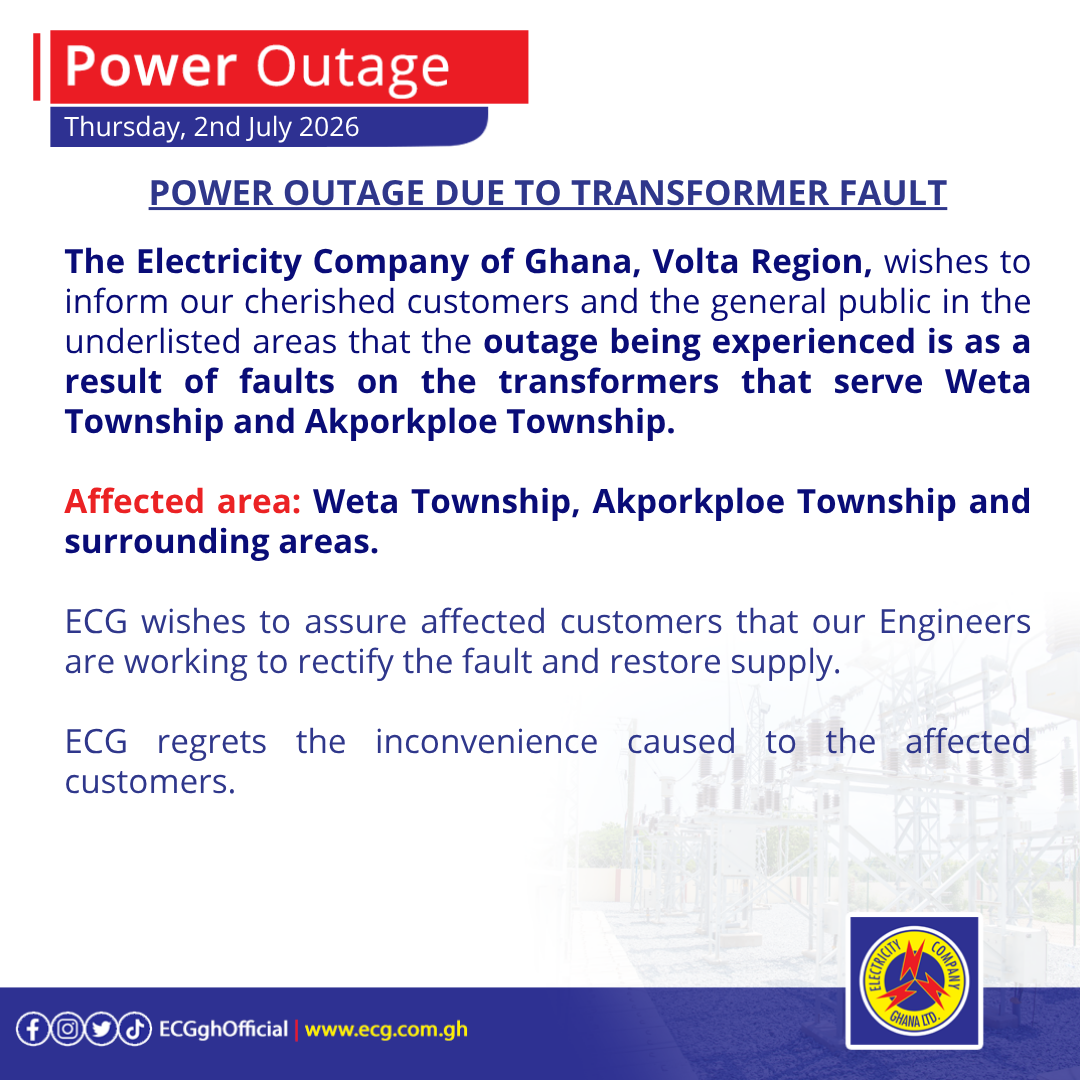
A major fault on Ghana's national power grid triggered widespread outages across multiple regions on July 29, 2026, leaving the capital Accra, the commercial hub Kumasi, and much of northern Ghana without electricity. The state-run power distribution company confirmed that several power plants across the country were forced to shut down in the early hours of Wednesday morning, cascading into what GhanaWeb reported as a nationwide blackout BBC, GhanaWeb.
Ghana Grid Company Limited (GRIDCo) issued a public statement acknowledging the disturbance. The transmission system operator said its engineers and system operators are working continuously to restore power "in the shortest time possible without compromising safety." GRIDCo also confirmed it is conducting a comprehensive technical investigation to determine the cause of the outage. It did not specify how long it would take for normal power supplies to resume BBC.
The impact was immediate and broad. Homes, businesses, and essential services across multiple regions were left without electricity. Many commuters struggled to get to work because uncharged phones prevented them from paying for transport or ordering taxis via apps such as Uber, an indication of how deeply mobile-dependent urban mobility has become in Ghana's major cities BBC.
This event did not occur in a vacuum. Ghana has experienced regular power shortages for years, popularly known as "dumsor," a term meaning "on and off" in the Akan language. The phenomenon has become politically salient over successive electoral cycles, with reliability of supply a persistent grievance among households and businesses alike. Most of Ghana's electricity is generated by ageing hydropower plants that have suffered from poor maintenance over years. In response to growing demand driven by population growth and urbanisation, Ghana has in recent years turned to gas-fired generation to supplement the hydro base BBC.
GRIDCo's own communications trail suggests systemic grid disturbances are recurring, not anomalous. The company's press releases page lists multiple "System Disturbance" notices over the past several years: a February 10, 2026 release titled "System Disturbance in Parts of the Transmission Network"; a June 29, 2026 release concerning a temporary shutdown of the Mallam and Achimota Primary Substations; a May 1, 2025 "System Disturbance" notice; a "System Disturbance — Northern Region" release dated February 7, 2024; another "System Disturbance" dated March 3, 2024; a "Power Systems Disturbance" notice dated September 8, 2023; and a "System Disturbance" release dated May 9, 2022 GRIDCo. As of this report, no press release dated July 29, 2026, appears on that page, though BBC reports that GRIDCo has issued a public statement on the current outage.
The frequency of these notices tells its own story. A transmission network that generates multiple system-wide disturbance reports annually points to structural vulnerabilities in generation adequacy, transmission infrastructure resilience, and maintenance regimes. The reliance on ageing hydro assets with documented maintenance deficits creates a fragile base load, and while gas-fired additions expand capacity, they introduce fuel-supply and pricing dependencies that complicate the dispatch picture. When a major fault propagates across such a system, the cascading shutdown of multiple plants is a symptom of insufficient redundancy and protective isolation, not merely the triggering fault itself.
For a country that has positioned itself as one of West Africa's more stable investment destinations, grid reliability carries weight beyond domestic politics. Mining operations, manufacturing, and the growing services sector all depend on predictable power. Each nationwide event erodes confidence in that predictability, and the absence of a restoration timeline from GRIDCo leaves businesses unable to plan around the disruption.
The broader context here is one of chronic underinvestment in transmission and distribution infrastructure meeting rising demand. Ghana's grid was built for a smaller, less urbanised economy. The rapid expansion of mobile-payment ecosystems and ride-hailing services, as demonstrated by the immediate knock-on effects on commuters, means that power outages now propagate into digital infrastructure disruptions with compound economic effects. The cost of a blackout is no longer measured only in lost industrial output but in frozen commerce across platforms that have become essential to daily economic life.
GRIDCo's investigation will need to identify not just the immediate trigger but the systemic conditions that allowed a single fault to cascade into a nationwide event. Until restoration is complete and findings are published, the episode will reinforce the perception that Ghana's power sector, despite generation diversification, remains structurally exposed to large-scale failures.