Nigeria Approves Tiered Military Pay Rise Taking Effect September 1

Nigeria's President Bola Tinubu has announced salary increases for the country's armed forces, with the most junior ranks receiving an 80% pay rise and senior officers seeing smaller percentage gains, effective September 1, 2026. The increase applies to approximately 250,000 military personnel across the army, navy, and air force, raising the armed forces' annual wage bill from $484 million to $678 million. BBC Business Insider Africa
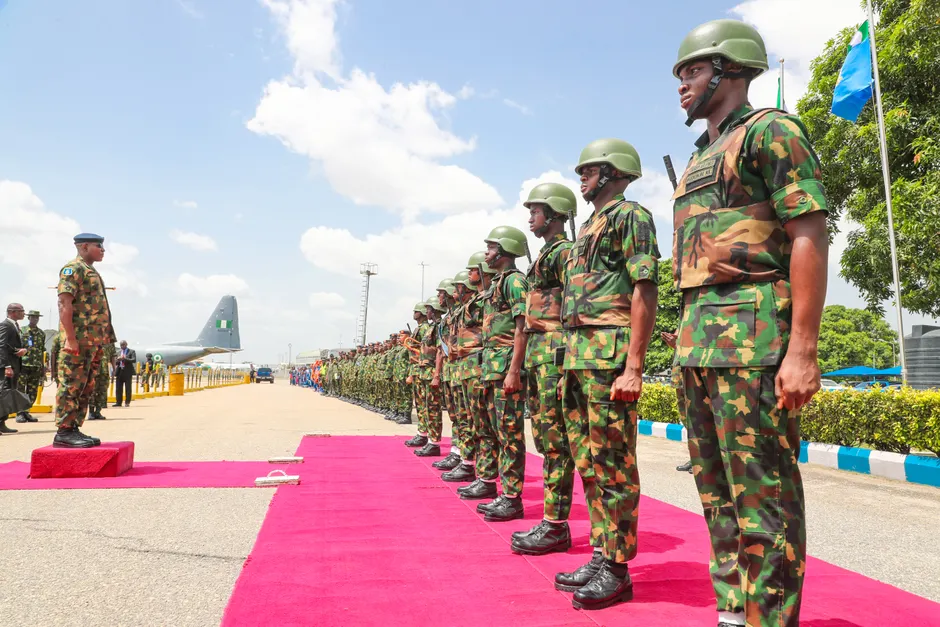
The structure is explicitly tiered to favour lower ranks. Privates through staff sergeants — the backbone of frontline deployments against banditry, kidnapping, and terrorism in Nigeria's north-west and middle belt — receive the full 80% increase. Warrant officers up to colonels receive a 50% rise. Brigadier generals through generals receive 30%. BBC
Tinubu announced the pay review alongside commitments to continue prioritising troop welfare and to modernise the armed forces with weapons and technology to address persistent security threats. He praised the courage and sacrifices of service members operating against multiple armed insurgencies and criminal networks. BBC
The structural reforms accompanying the pay rise include an expansion of the Nigerian army to 12 divisions spread across the country, designed to improve inter-unit coordination, intelligence sharing, and response times to security incidents. BBC Punch
Retired Major General Bashir Galma, a military expert, described the pay rise as what the armed forces had been calling for "for a long time." Galma tempered his approval with a concern about fiscal durability: future administrations may struggle to sustain the elevated funding level. He also argued that other security agencies should receive comparable pay reviews and that broader welfare deficits — including uniforms, boots, and new rifles — still required attention. BBC
The tiered structure, which front-loads the largest percentage gains to the lowest ranks, is unusual in Nigerian military compensation history, where across-the-board adjustments have been more common. The decision to weight the increase toward enlisted personnel and junior NCOs directly acknowledges the retention and morale challenges among the ranks most exposed to combat casualties in the north-east, north-west, and north-central theatres.
The fiscal arithmetic is worth examining. The approximately $194 million annual increase in the wage bill comes at a time when Nigeria's federal government is navigating competing budgetary pressures, including fuel subsidy removal adjustments and currency devaluation effects on defence procurement costs. The wage bill jump — roughly a 40% increase over the previous $484 million baseline — is a recurring expenditure, not a one-time allocation, which is precisely what makes Galma's sustainability concern salient. Recurrent personnel costs in Nigeria's defence budget have historically crowded out capital allocations for equipment and infrastructure, and a structurally higher wage bill without corresponding revenue growth could deepen that imbalance over time.
The parallel announcement of a 12-division army restructuring suggests an effort to pair the compensation measure with an operational logic: more divisions imply more dispersed command nodes, which could reduce the latency between intelligence detection and kinetic response in contested zones. Whether the expanded divisional structure is matched by commensurate increases in equipment, logistics, and officer staffing is not addressed in the announcement, and that gap is where Galma's reference to uniforms, boots, and rifles becomes operationally relevant. A 12-division army that is better paid but under-equipped does not necessarily translate into improved combat effectiveness.
The timing, just under four weeks before implementation, gives the Ministry of Defence and the military's pay administration systems a narrow window to recalibrate payroll structures across three services and multiple rank tiers. The Defence Headquarters has not publicly detailed the administrative mechanism for the transition.