Nigeria's Tinubu Approves Largest Military Expansion in Recent Memory
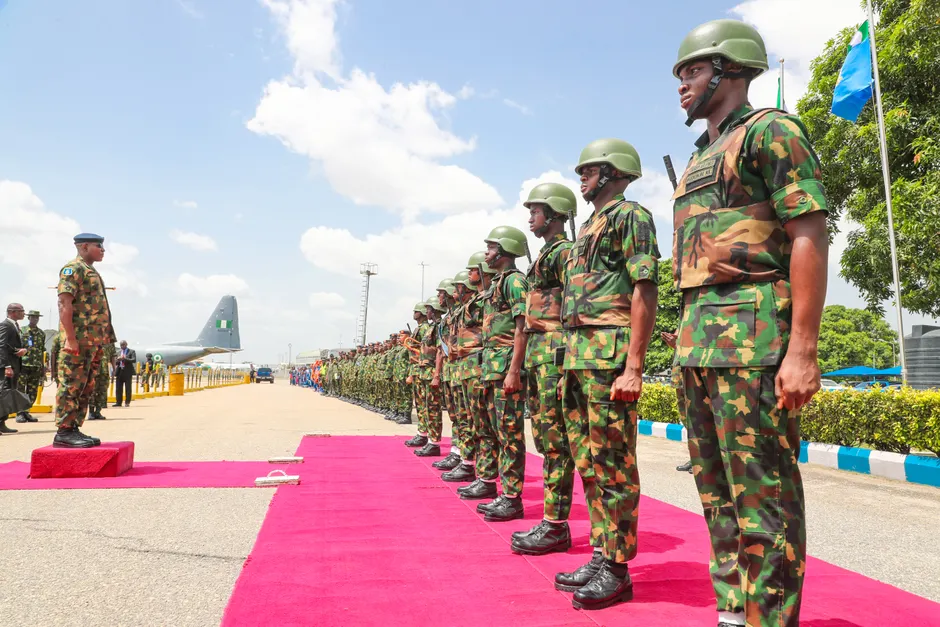
Nigeria's President Bola Tinubu has approved the country's largest military expansion in recent times, authorising the recruitment of 28,000 additional soldiers and the creation of four new army divisions, according to reporting from the BBC, Reuters, and Nigeria's Punch newspaper on July 24, 2026.
The four new divisions will bring the Nigerian army's total to 12. The expansion targets long-standing structural weaknesses in the army's operational footprint: under the current structure, multiple divisions cover vast areas spanning entire states, leaving resources stretched and response times slow. The Nigerian government stated the new divisions would ensure better co-ordination, intelligence sharing, and faster response times.
The approval builds on a security emergency Tinubu declared in November 2025, when he ordered both the army and the police to recruit additional personnel. Under that declaration, the Nigerian police were authorised to recruit 20,000 more officers, and the army was directed to expand its ranks as well. The State House published the emergency declaration on its official website at the time.
Notably, the Nigerian State House news landing page did not display any press release concerning the military expansion approval at the time it was accessed, even as international wire services and domestic media carried the story. Reuters, the BBC, and Punch all reported the expansion on July 24, 2026, citing the approval and its specific parameters.
The expansion lands against a backdrop of acute, multi-front insecurity. In the week preceding the BBC's report, an armed gang killed at least 20 villagers in Zamfara state in north-western Nigeria. Separately, 46 students were abducted from a school in Borno state in the north-east. The Nigerian army rescued those students hours after they were taken, a rare rapid-response success that nonetheless underscores the frequency and severity of the incidents the security forces are confronting.
The geographic spread is itself part of the problem the expansion is designed to address. Nigeria's security challenges span the north-east, where Borno state remains a flashpoint for abductions and insurgent activity; the north-west, where Zamfara and neighbouring states have seen escalating bandit violence; and other regions grappling with separatist agitation, kidnapping for ransom, and intercommunal conflict. A division structure that stretches single units across multiple states complicates both intelligence-gathering and operational deployment, particularly when threats emerge simultaneously in different theatres.
The broader context here is one of an overstretched military attempting to cover too much ground with too few troops, a problem Nigeria has grappled with for years across successive administrations. The creation of four new divisions is a structural response to that problem, aimed at reducing the operational footprint of each division and enabling more localised command and control. Whether 28,000 new recruits, distributed across those divisions, will be sufficient to close the gap between demand and capacity is a question that will turn on recruitment timelines, training throughput, equipment availability, and retention.
The police expansion authorised under the November 2025 security emergency runs in parallel. An additional 20,000 officers, if fully recruited and deployed, would augment the civilian policing layer that complements military operations, particularly in areas where the army has been forced into roles that would ordinarily fall to police, such as routine security patrols and checkpoint management.
The timing of the expansion approval, coming roughly eight months after the security emergency declaration, suggests a lag between policy directive and concrete implementation planning. The specific parameters now reported, 28,000 soldiers and four divisions, represent the operational detail that follows from the broader mandate Tinubu issued in November 2025.
For regional security partners and observers, the expansion carries implications beyond Nigeria's borders. Nigeria remains the dominant military power in the Economic Community of West African States (ECOWAS) and has historically contributed to regional peacekeeping and counter-terrorism operations. A military focused heavily on internal security deployments has less bandwidth for external commitments, and the expansion could, over time, ease some of that pressure. Much depends on how quickly the new divisions are stood up and whether the recruitment targets are met.