Europe Is Talking Directly to Russia While Worrying the U.S. Might Walk Away
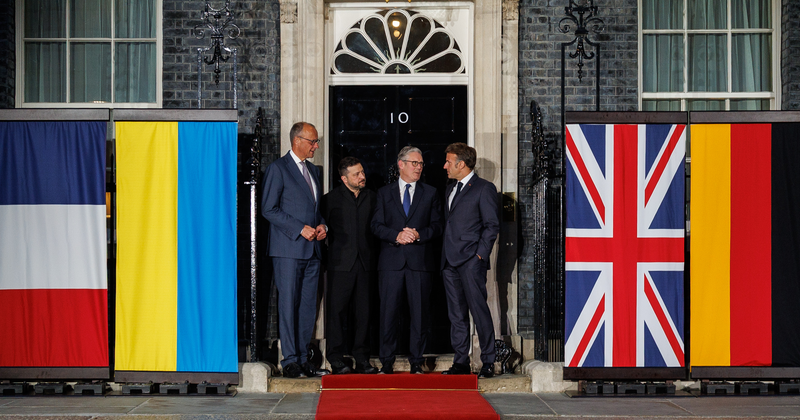
European leaders are reaching out to Moscow on their own while insisting that any peace deal for Ukraine must include Europe at the table. This is happening because they are deeply unsure whether the United States, under President Trump, will stay committed to NATO — the military alliance that has protected Europe for 80 years.
On June 7, 2026, the leaders of France, the United Kingdom, Germany, and Ukraine issued a joint statement. They said Europe had an "important role to play in any settlement" as a "steadfast supporter of Ukraine" Élysée Palace. That same day, the British, German, and French leaders backed Ukrainian President Zelenskyy's call for direct talks with Russian President Putin to try to secure a ceasefire. A ceasefire is an agreement to stop shooting, at least temporarily Reuters, Deutsche Welle.
Three countries — the United Kingdom, France, and Germany — have been the main voice for Europe in Ukraine peace talks. This group is called the E3 New York Times. Their leaders have voiced "unwavering support for Ukraine" and set out five conditions for ending the conflict French Diplomacy.
Days later, on June 11, 2026, the ambassadors of France, Germany, and Britain in Moscow met Russia's deputy foreign minister. They condemned the latest escalation in the Ukraine conflict Reuters. The French and German ambassadors urged direct talks between Moscow and Kyiv in a rare meeting at Russia's foreign ministry The Guardian.
These diplomatic efforts come as European leaders are alarmed by U.S. policy under President Trump. In February 2025, Trump sided fully with Russia's story that Ukraine was to blame for the war. This made European leaders feel that the U.S. president was walking away from the shared agreement between the U.S. and Europe that NATO and collective defense are the foundation of Western security New York Times. By December 2025, a New York Times analysis argued that Trump's main goal was not peace in Ukraine but a warming of relations with Russia — a country actively trying to weaken NATO New York Times.
European leaders need U.S. support to help Ukraine against Russia, so they have been careful about criticizing Trump on Greenland, Iran, and Ukraine, according to reporting from January 2026 New York Times. Yet as Trump has tried to pressure European leaders over Greenland, they have wondered whether the 80-year-old NATO alliance is doomed New York Times.
European officials who dealt with the Trump administration found his officials "polite but consumed with fulfilling the president's wishes and expressing little," as reported in April 2025 New York Times.
European countries have also been coordinating more closely through a framework called Weimar+. Think of it as an expanding club of European nations working together on security. The United Kingdom, France, Germany, and other partners issued a Weimar+ joint statement about how to further step up European efforts to support Ukraine against Russia's invasion UK Government. On June 12, foreign ministers from France and other European countries met in Rome to discuss security and Russia's aggression against Ukraine German Federal Foreign Office. India is scheduled to attend the Weimar Triangle meeting in Paris, which will focus on the situation in Ukraine and strengthening Europe's security German Federal Foreign Office.
The broader context here is a deep split between Washington and its European allies over Russia's role in the security order of Europe and North America. European governments now assume that Trump's policy is not just about ending the fighting in Ukraine. They believe he wants a bigger realignment that would give Moscow what it wants, including its goal of weakening NATO. This assessment has pushed European governments to run two diplomatic tracks at once: backing Zelenskyy's call for direct talks with Putin, and building up the Weimar+ and E3 formats so that any peace deal cannot bypass Europe.
The decision to send the French and German ambassadors to Russia's foreign ministry signals a shift in how Europe is approaching diplomacy. Instead of waiting for U.S.-led negotiations to finish, European countries are willing to talk to Moscow on their own. The inclusion of India in the Weimar Triangle discussions suggests an effort to bring more countries into the conversation, which could make it harder for Russia to say this is only a dispute between Moscow and Kyiv.
The five conditions from the E3 leaders, plus the joint statement asserting Europe's role in any settlement, add up to a European red line. Their message is that Ukraine's supporters must be at the table when the terms are written. Whether Moscow will accept these conditions, and whether Washington will accept a European role that limits its own agenda with Russia, is the central unresolved tension.
For now, European governments are playing it safe on multiple fronts. They support Ukraine while opening diplomatic lines to Russia. They participate in NATO while questioning whether the alliance has a future under the current U.S. administration. They engage with Trump officials while preparing for a world where the security guarantee from the U.S. that has protected Europe since 1949 may no longer be there.


