What's Going On With All the Hummingbird Hawk-Moths in the UK?
The UK is seeing a big wave of hummingbird hawk-moth sightings in 2026. The charity Butterfly Conservation says it has received far more reports and questions about the insect than usual, and scientists are trying to figure out whether there are actually more of these moths around, or whether other factors are at play.
Richard Austin, a recording schemes officer at Butterfly Conservation, told the Guardian that the charity had received a big increase in hummingbird hawk-moth sightings and inquiries in 2026. He cautioned, however, that it was too early to compare 2026 numbers with previous years, as the data remains incomplete (The Guardian). Butterfly Conservation Yorkshire went further in a monthly sightings update, describing the species as having a "record breaking year" in 2026, though that characterisation predates any formal national tally.
Early-season records lend weight to the sense of an unusually active year. A hummingbird hawk-moth was sighted in Richmond Park, Surrey, on March 2, 2026, recorded by Nigel Jackman. Three days later, on March 5, Ian Fisher reported one at Doddington Hall in Lincolnshire. A further sighting came from a garden in Paignton, Devon, on April 6, reported by Anthony Sherwood. These early records, logged through Butterfly Conservation's regional branch networks, fit the broader pattern of elevated reporting across England through spring and into summer.
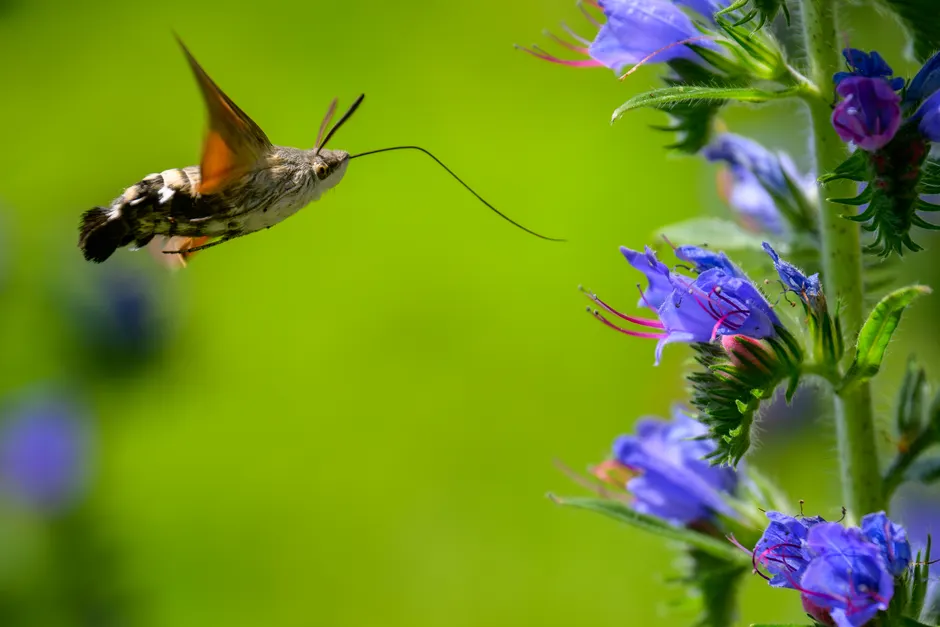
The hummingbird hawk-moth is a moth that flies during the day, unlike most moths. It gets its name from the way it feeds: it hovers in front of flowers, beating its wings very fast, and uses a long, straw-like mouthpart called a proboscis to drink nectar. It is native to southern Europe and the Mediterranean area and travels to the UK as a migrant, carried north on warm winds. The insect does not usually survive UK winters, in either its adult or caterpillar stage, though that may be changing.
Richard Harrington, an honorary fellow of the Royal Entomological Society, told the Guardian that warm southerly winds associated with recent heatwaves could have helped bring high numbers to the UK. He also pointed to a second possible driver: the plants that hummingbird hawk-moth caterpillars feed on may be drying out in the species' Mediterranean breeding areas, potentially pushing populations northward in search of better habitat (The Guardian).
A third factor complicates the picture. Ray Barnett, a council member at the British Entomological and Natural History Society, told the Guardian that sunny UK weather may have encouraged more people to spend time in their gardens, raising the chances of spotting hummingbird hawk-moths. In other words, an increase in reported sightings may partly mean more observers, not necessarily more moths. This is a known challenge in citizen-science projects, where the number of reports often depends on how many people are outdoors looking.
The question of whether the species could become a permanent UK resident has also come up. Barnett told the Guardian that hummingbird hawk-moths could become a resident UK species rather than purely migratory if milder winters continue due to global warming. This is a conditional projection, not a confirmed event, and it depends on long-term climate trends rather than a single year's data.
What makes 2026 notable is not any one of these factors alone but the way they have all lined up at once. Southerly winds, possible habitat problems in the Mediterranean, good UK weather, and more public engagement have all come together in the same period. Separating these factors will require data from the full recording season and, ideally, comparison across multiple years. Austin's caution against premature year-on-year comparison reflects the discipline that citizen-science reporting demands: a surge in inquiries is a signal worth investigating, not a conclusion in itself.
The broader context here is one of species on the move and the difficulty of pinning any single season's pattern to one cause. The hummingbird hawk-moth is a useful bioindicator, meaning its behaviour and population changes can tell us something about wider environmental shifts. It travels easily, reacts quickly to weather systems, and relies on specific plants whose condition reflects broader climate changes. If Mediterranean drying is pushing the species northward, the UK sightings could be an early sign of range contraction at the southern edge and expansion at the northern edge, a pattern seen in other butterfly and moth species. If warm winters eventually allow the moth to survive the cold season in the UK, it would join a growing list of insects from mainland Europe setting up permanent populations in Britain as the climate warms. For now, both ideas depend on conditions that are still uncertain, and the data needed to test them is still being collected.