A Drone Strike Hit a Village Gathering in Sudan. Here's What Happened.
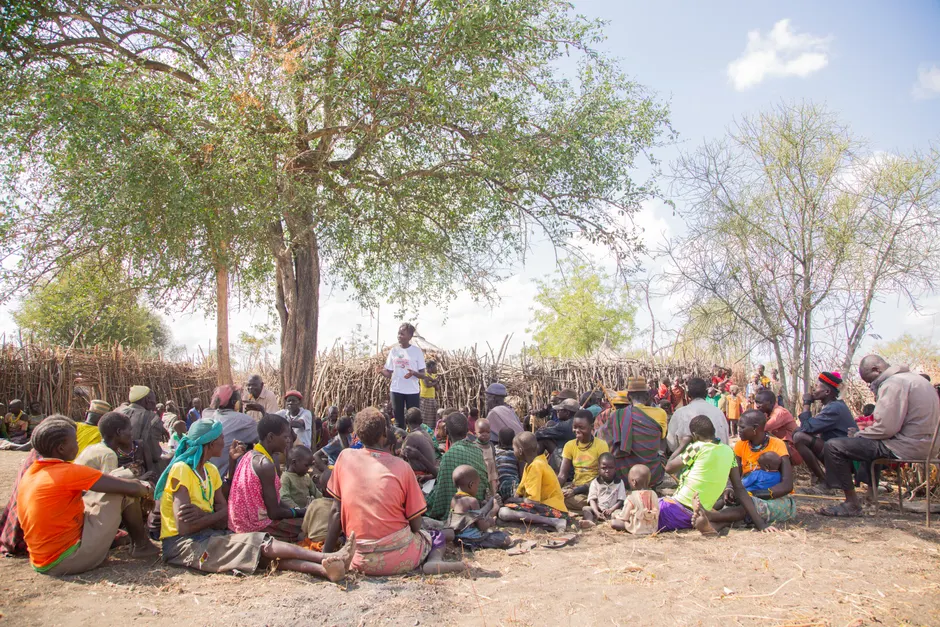
A drone strike by the Sudanese army hit a traditional court session in the village of Ghara al-Zawiya, in northern Darfur, on Sunday afternoon. At least 35 people were killed, according to the Emergency Lawyers Group. Dozens more were injured. The attack targeted a community gathering held under a tree, with local tribal leaders taking part. BBC
The Emergency Lawyers Group, which tracks violence against civilians in Sudan, said the village is controlled by the Rapid Support Forces, or RSF. The RSF is a paramilitary group — that is, an armed force that operates outside a regular national army. The RSF holds most of Darfur, a region in western Sudan. The Sudanese army has not commented on the strike. BBC
A witness quoted by AFP said four tribal leaders and two RSF commanders were among those killed. A local resident told the Darfur 24 website that two drones flew over the town before launching more than four missiles. BBC
The RSF's self-declared parallel government condemned the strike as "a horrific crime." It reported 37 people killed and 50 wounded. The difference in casualty numbers between the Emergency Lawyers Group (35 killed) and the RSF's government (37 killed) could not be independently confirmed. France 24
Al Jazeera also reported the strike on August 2, 2026, citing the Emergency Lawyers Group's count of 35 killed. Al Jazeera
The Emergency Lawyers Group called for an investigation. It described attacks on civilians and civilian infrastructure as a serious violation of international humanitarian law — the set of rules, agreed by nations, that aims to limit the harm done to civilians during war. The group noted that drones are being used more and more to target civilian areas and gatherings, putting the population at greater risk. BBC
Sudan's civil war has lasted about three years. It has killed tens of thousands and forced millions from their homes. The conflict pits two sides against each other: the Sudanese Armed Forces, which support the country's transitional government based in Port Sudan, and the RSF, which controls large parts of Darfur and other western regions. Both sides have faced credible accusations of atrocities. The RSF has been accused of war crimes, including drone attacks on civilians. A UN fact-finding mission said the RSF's siege and attack on el-Fasher last year bore the hallmarks of genocide. The RSF has denied the genocide accusations. BBC
The broader context here matters for understanding what this strike might tell us about where the conflict is heading. The gathering that was hit was a traditional court session — a form of community justice that existed long before Sudan was a modern state and still serves as a core part of local governance in Darfur. In communities where formal courts have collapsed under wartime conditions, these traditional courts are essentially the local government. If the strike was deliberate, it suggests the army may be trying to disrupt how local communities are governed in RSF-held territory, not just going after fighters.
The reported presence of two RSF commanders among the dead complicates the picture. Under international humanitarian law, any military strike is supposed to be proportionate — meaning the expected military benefit must outweigh the harm to civilians. The fact that military figures and civilians were gathered in the same place raises the question of whether the army had a legitimate military target or simply treated a civilian gathering as a military one.
The Emergency Lawyers Group's point about the growing use of drones against civilian gatherings fits a pattern seen in other conflicts. Drones make it easier to strike groups of people because the attacking force faces almost no risk to its own soldiers. There is no need to send troops on the ground. In Darfur, where people routinely gather under trees for social and judicial events, this is especially dangerous.
The different casualty counts — 35 from the Emergency Lawyers Group and 37 from the RSF's government — reflect how difficult it is to get reliable information out of Sudan. Access is severely limited by fighting and travel restrictions, so neither number can be independently confirmed right now.
Sudan's civil war is now in its third year, and there is no real peace process underway. The RSF controls most of Darfur and has set up its own governing authority. The army-backed government operates from Port Sudan. Mediation efforts by Saudi Arabia, the United States, and the African Union have not produced a durable ceasefire — a lasting agreement to stop the fighting. The siege of el-Fasher, which a UN mission said bore the hallmarks of genocide, remains a flashpoint. In this environment, a strike on a community court in northern Darfur, whatever the military reasoning, adds another grim chapter to a conflict already full of accusations of atrocities on both sides.