Linkdaze's Wall-Mounted Smart Calendar Takes On Skylight With No Subscription
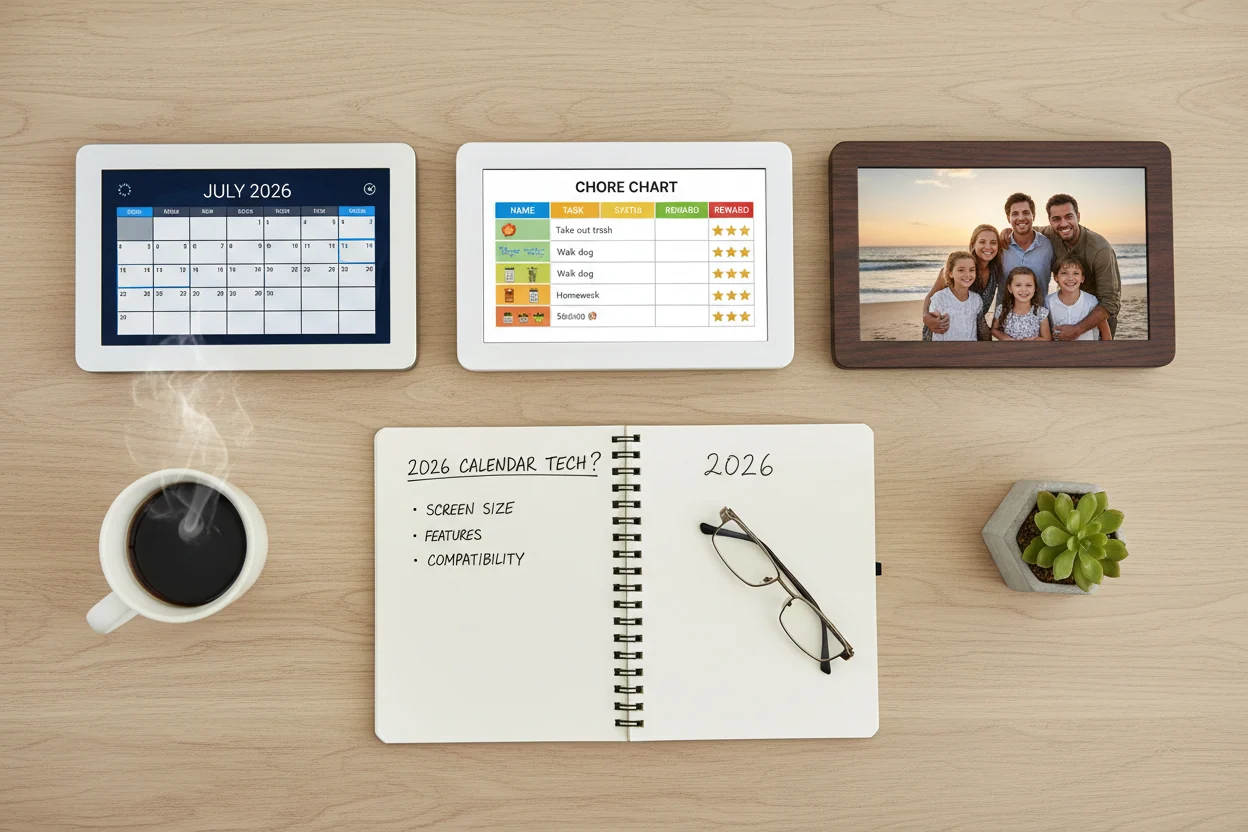
Linkdaze has built a wall-mounted touchscreen calendar built to coordinate an entire household's logistics rather than serve as a single-user scheduling tool. The device pulls in calendars from Google, iCloud, Outlook, Yahoo, and Cozi, then color-codes each family member across the merged view (TechCrunch).
The calendar ships in a 15.6-inch and a 10.1-inch model, both with an included stand and wall-mount support. The 10.1-inch model runs $119.99, which sits below Skylight's competing 10-inch calendar at $159.99. Linkdaze also does not require a monthly subscription for its core features, a contrast with Skylight, which gates additional capabilities behind a $79-per-month subscription tier.
Beyond calendar aggregation, Linkdaze folds in chores and rewards, meal planning, shopping lists, and a digital photo-frame mode. The chore-and-rewards system lets children earn stars toward a prize, and the interface is designed so kids can interact with the chore tracker on their own (linkdaze.com/blogs/news). The family-organization focus extends to shared schedules across multiple family members or team members, not just syncing between two paired devices (linkdaze.com/blogs/news).
The standout feature is the AI meal planner's "Snap-to-Sync" tool. Snap a photo of a paper recipe or a child's school lunch menu, and the device converts the image into a digital meal plan, then generates a matching shopping list. The meal planner more broadly suggests recipes and builds a corresponding grocery list. All of these capabilities, including real-time calendar sync and AI meal planning, ship with the hardware purchase at no extra cost, according to the company's blog posts (linkdaze.com, linkdaze.com/blogs/news).
Linkdaze makes the subscription question a core part of its marketing. The company publishes a comparison guide titled "2026 Family Calendar Recommendations: A No-Subscription Smart Calendar Comparison" that weighs Linkdaze against Skylight, Apolosign, and Cozyla on subscription cost (linkdaze.com/blogs/news). A separate buyer's guide, "Subscription-Free Smart Display for Calendar and Chores," reinforces the same message (linkdaze.com/blogs/news). These are vendor-authored comparisons, so the framing should be weighed accordingly.
The broader context here is a familiar pattern in consumer hardware: a new entrant tries to differentiate on total cost of ownership rather than feature parity at launch. Skylight established the smart-calendar category with a subscription-augmented model, and Linkdaze is betting that households will prefer a one-time hardware purchase over a recurring fee that, at $79 per month, approaches $950 annually. Whether the feature gap between the two platforms justifies that price difference for most families is a question the market will answer. Snap-to-Sync is a genuinely useful application of image processing for a household use case, but the broader feature set, chores, meal planning, photo frames, is not new territory.
What is less clear from the available information is the device's underlying platform. Hardware specifications, the operating system, app ecosystem, and data-handling practices for the calendar and image data that flow through Snap-to-Sync are not detailed in the reporting. For a device that aggregates multiple family members' calendar data from five different cloud providers and processes photographs of school documents, those are not trivial gaps. Anyone evaluating this for a household should treat the subscription-free pricing as the headline and dig into the privacy and data-retention details before committing.
The positioning is straightforward: a capable household coordination device at a competitive hardware price, with no recurring fee. The execution details that would let a technically inclined buyer make a full assessment — platform, security model, API access, update cadence — remain to be documented.