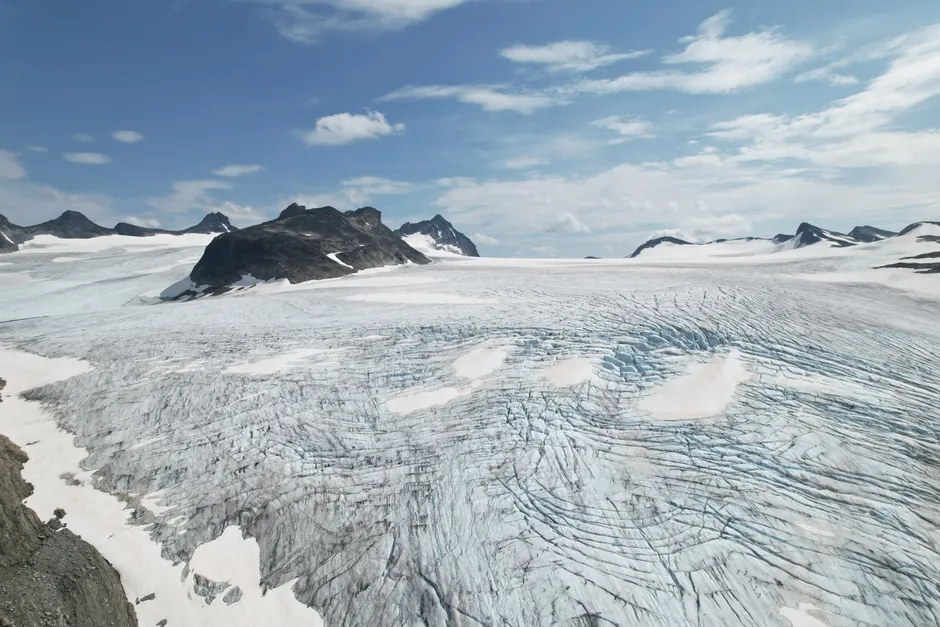
Glacial Collapse Triggers Catastrophic Flood on the Nepal-Tibet Border

A glacial collapse on 26 August 2026 set off a debris-laden flash flood that roared down valleys along the Nepal-Tibet border, destroying entire villages and leaving a preliminary death toll of at least 165 people, according to the US Geological Survey. Rescuers on 27 August were racing to find hundreds of missing people across the flood zone, including nationals from India, the United States, the United Kingdom, Australia, Canada, and several other countries.
Nepal's national disaster authority said an initial review of Planet Labs satellite imagery pointed to a landslide of ice and rock that triggered the debris flow in the Lhende River, roughly 20km north-east of the Rasuwagadhi border crossing between Nepal and China. The USGS clarified that what was first reported as a 4.4 magnitude earthquake was actually a seismic shock — the vibration generated by the collapse itself and the movement of debris — and that no earthquake had taken place.
Nepal police said 165 bodies had been recovered by late Wednesday, 26 August. Chinese state media reported three dead on the Tibet side of the border. Nepal's tourism ministry said 468 tourists and travellers, including 393 foreign nationals, were unaccounted for in the flood-affected mountainous region. Chinese state media reported at least 558 people missing on the Tibet side, of whom at least 260 were foreign nationals. Taken together, well over 1,000 people remain unaccounted for across both sides of the border.
According to the Nepal tourism board, the missing foreign nationals on the Nepal side included 142 Indian citizens, 47 Americans, 34 Australians, 33 Britons, and 24 Canadians. Al Jazeera reported that citizens of Malaysia, the Netherlands, Portugal, and South Africa were also among the missing. Many of those caught in the flood were on a pilgrimage to Kailash Mansarovar, a high-altitude site in Tibet sacred to Hindus and Buddhists. That placed a large concentration of foreign travellers in a remote, high-altitude corridor at the exact time of the disaster.
Earlier reporting on 26 August reflected a rapidly changing picture. NPR reported at least eight dead and hundreds missing that day, while Reuters and the Associated Press each reported at least 157 bodies recovered. By 27 August, the Guardian and AP had updated the confirmed death toll to 165. Reuters reported on 27 August that officials at Nepal's tourism ministry told media that around 340 foreigners were among more than 400 tourists missing after the disaster.
Experts attributed the disaster to a glacial collapse in the warming Himalayan region. A 2025 Asian Development Bank assessment found that climate-related disasters cost Nepal approximately $221 million annually, alongside significant human casualties, and that more than 50 of Nepal's 77 districts are affected by climate-related disasters.
The broader context here is the accelerating pace of high-altitude glacial hazards across the Hindu Kush-Himalaya. The mechanism in this event — a collapse of rock and ice generating a debris-laden flood — fits processes that researchers have identified as intensifying under warming conditions. Glacial retreat can destabilise adjacent rock faces, and permafrost (permanently frozen ground that acts like glue holding mountain slopes together) degrades as temperatures rise, weakening that internal cohesion. When these failures cascade into river channels, the resulting debris flows can travel tens of kilometres with destructive force far exceeding that of a conventional water-only flood.
The international dimension of the missing-persons count stems directly from the Kailash Mansarovar pilgrimage route, which draws devotees from across South Asia and the global diaspora through the same trans-Himalayan corridor that bore the brunt of the debris flow. The large number of foreign nationals unaccounted for on both sides of the border will place significant pressure on consular response mechanisms across multiple governments, and on the bilateral coordination between Kathmandu and Beijing, given that the affected zone straddles the Nepal-China frontier.
The satellite-based rapid assessment conducted by Nepal's national disaster authority, using Planet Labs imagery, points to the growing role of commercial earth observation in early disaster characterisation, particularly in remote terrain where ground access is delayed. Identifying the precise trigger point and flow path within hours of the event allows rescue operations to concentrate resources along the debris flow's likely deposition zone, though the sheer scale of the missing across two national jurisdictions means that access, terrain, and weather will constrain search operations for days.
What remains uncertain is the final toll. The gap between confirmed recoveries and reported missing — exceeding 1,000 people across both sides of the border — suggests the death count will climb substantially as search teams reach areas currently cut off. The remoteness of the affected river valleys, the mixed Nepalese and Chinese jurisdictional terrain, and the presence of a large multinational pilgrim population together make this one of the most complex disaster response operations the trans-Himalayan region has faced in recent years.