Glacier Collapse Near Nepal-Tibet Border Kills 168, Leaves Over 1,300 Missing

At least 168 people are dead and more than 1,300 remain missing after a glacier collapsed near the Nepal-Tibet border on August 26, 2026, sending catastrophic floods and mud cascading through Himalayan river systems on both sides of the frontier. The disaster struck a corridor heavily trafficked by pilgrims traveling to or from Mount Kailash, a sacred site revered in Hinduism, Buddhism, Jainism, and Bon traditions, compounding the human toll and complicating rescue operations across difficult, high-altitude terrain. AP
The most recent figures, reported by the Associated Press on August 28, put the death toll at 168 and the number of missing at more than 1,300. Earlier reporting on August 26 had cited nearly 1,000 missing; the figure climbed as communication reached cut-off areas and families reported uncontactable relatives. Reuters reported on August 27 that rescuers were searching for nearly 1,500 missing people, including more than 700 foreigners. More than 100 of the missing were pilgrims on the Kailash route, according to The Globe and Mail.
Over 100 Indian pilgrims were among the missing, many traveling to or from Mount Kailash, the New York Times reported on August 26. Around 600 Indian pilgrims who had undertaken the Kailash Mansarovar Yatra — a sacred pilgrimage — through private tour operators were stranded in Taklakot (known in Chinese as Burang), a trading town on the Tibetan side that serves as a staging point for the pilgrimage.
India's Ministry of External Affairs confirmed on August 27 that Indian nationals who had gone on the Kailash Mansarovar Yatra were stranded, with Official Spokesperson Randhir Jaiswal briefing the press specifically on the Nepal situation. The MEA identified a group associated with the Isha Foundation among the stranded pilgrims. The ministry established a Special Control Room to coordinate its response to the Nepal floods and issued an advisory for Indian citizens undertaking the Kailash Manasarovar pilgrimage. MEA Briefing, August 27
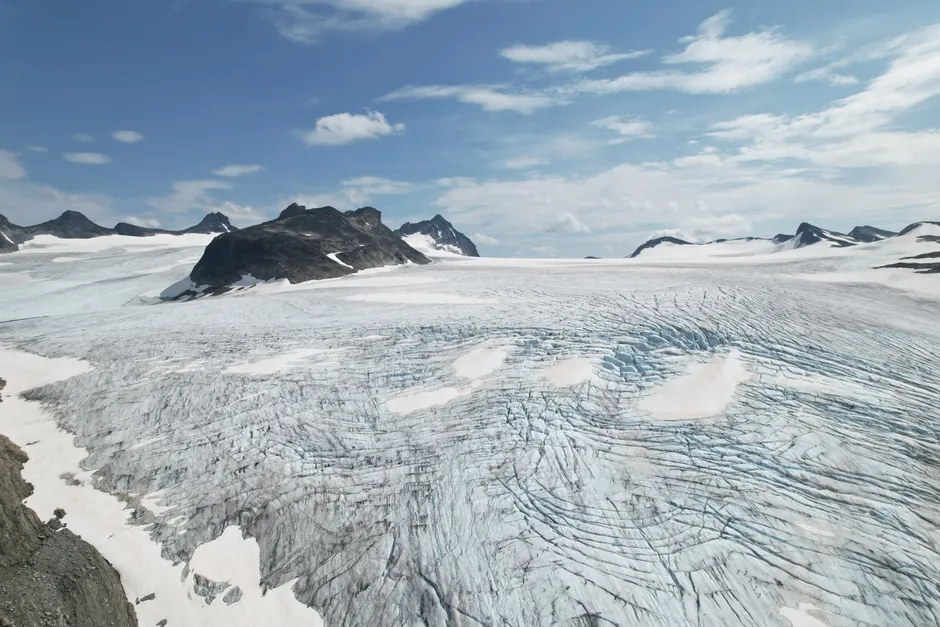
The Lhende Khola river system has now flooded twice in 14 months, according to Aspen Public Radio, pointing to an increasingly unstable Himalayan ice system. Glacial lake outburst floods, or GLOFs, happen when a natural dam of ice or rocky debris holding back a glacial lake suddenly fails, releasing impounded water in a sudden, high-volume surge. The Himalayan cryosphere — the frozen-water portion of the region's environment — has warmed at rates exceeding the global average, accelerating both glacier mass loss and the formation of proglacial lakes (lakes formed in front of retreating glaciers) that are structurally vulnerable to collapse. A repeat flood event on the same river system within just over a year signals that the instability is not episodic but systemic to the watershed.
The disaster's intersection with the Kailash Mansarovar Yatra adds a diplomatic dimension to the humanitarian response. The pilgrimage route crosses from Nepal into the Tibet Autonomous Region of China, meaning stranded nationals must be evacuated through coordinated Nepal-China-India channels. India's MEA engagement suggests New Delhi is managing the crisis through established consular and diplomatic tracks, though the operational details of any cross-border evacuation depend on cooperation from Chinese authorities controlling access to Tibetan territory.
The casualty figures remain fluid. The gap between the August 26 report of nearly 1,000 missing and the August 28 figure of over 1,300 reflects the pace at which information is emerging from remote, communication-degraded areas. The death toll of 168, reported on August 28, is likely provisional given the scale of the missing population and the difficulty of accessing affected zones. Families of pilgrims, many of whom traveled through private operators rather than the Indian government's organized yatra batches, have struggled to obtain information, as Reuters documented on August 27.
The broader context here extends beyond the immediate humanitarian catastrophe. The Lhende Khola's repeat flooding within 14 months places this event within a pattern of accelerating cryospheric hazards across the Hindu Kush-Himalaya, where warming rates and glacial retreat are producing conditions that outpace the risk-assessment infrastructure of the states sharing the range. The Kailash corridor, drawing thousands of pilgrims annually across a geopolitically sensitive border, is now also a corridor of acute climate vulnerability, and the institutional capacity to manage that intersection — whether through early warning systems, transboundary data sharing, or coordinated evacuation protocols — has not yet been tested at the scale this disaster demands.