Anker's Eufy MindBase Brings On-Device AI to Home Security

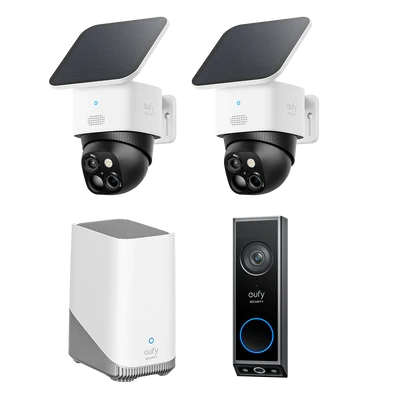
Anker has announced the Eufy MindBase, a local AI hub for its Eufy security cameras, at the IFA 2026 trade show in Berlin. The device runs a large language model (LLM) developed by Anker itself, processing camera footage on the hub rather than sending it to the cloud. Anker positions the MindBase as a "central brain for the home," combining on-device AI processing with local storage. The Verge
The MindBase is Anker's first AI hub, announced as part of a broader 22-product IFA launch that also includes headphones, earbuds, power banks, and chargers. Tom's Guide The hub's connectivity options are wide-ranging: dual-band Wi-Fi, Bluetooth, Thread, and Zigbee. It functions as a Matter controller running Matter 1.5, supporting over 40 Matter device categories including lights, sensors, and HVAC systems. For readers less familiar with Matter, it is a smart-home standard designed so that devices from different brands can work together regardless of which ecosystem you use. The MindBase is also compatible with Apple HomeKit Secure Video, Amazon Alexa, Google Home, and Home Assistant, giving it reach across every major smart-home platform as well as the open-source community.
On the hardware side, the MindBase offers up to 48TB of expandable storage alongside a dedicated AI chip. That is a substantial increase over Eufy's existing HomeBase S380 (HomeBase 3), which uses BionicMind AI and caps out at 16TB of expandable local storage. Eufy The new hub supports 16 wireless cameras, four wired cameras, and 34 sensors. It also includes a new Smart Security Shield sensor using 180-degree dual radar for movement detection.
The AI capabilities are where the MindBase diverges most sharply from conventional security hubs. Natural-language search across recordings and AI-generated event summaries are available without a monthly fee, meaning you could type something like "show me the delivery that arrived Tuesday morning" and get a relevant clip. Smart alerts cover facial recognition and people, car, pet, and stranger detection. A digital credential stored on household members' phones lets the system recognize friends and family to reduce unnecessary alerts. Eufy Security spokesperson Janet Jin told The Verge that Eufy plans to integrate Matter-compatible third-party cameras with the MindBase as well.
Anker's roadmap extends beyond security cameras. The company plans to add an energy agent for home power management and a clean agent for robot vacuums, expanding the MindBase's scope from a security-focused device toward whole-home orchestration.
One of the first products designed for the MindBase is the Eufy TrackLight Cam S1, part of an Anker MindBase Security Kit. The TrackLight Cam S1 is a camera designed to actively deter intruders, with an auto-tracking light, 180-degree dual-radar detection, and 4K resolution. Anker says the MindBase will also support existing cameras like the eufyCam S4. The new wired Eufy S4 video doorbell, launching the week of the IFA announcement, is likewise compatible. Priced at $299.99, the S4 doorbell features a 180-by-180 panoramic field of view, AI-powered tracking and auto-zoom, 3K-capable recording, 64GB of onboard storage, Wi-Fi 6, and a combination of radar and PIR (passive infrared, a common motion-detection technology) for motion detection. Its Eufy app offers what Anker describes as an "immersive virtual reality-inspired mobile experience," displaying panoramic footage that users can navigate by moving their smartphone.
Anker also announced the $70 E10 window camera, arriving later this year, designed for users who cannot install exterior cameras. It adheres to the inside of a window and records in full HD, with onboard local storage and tool-free installation.
Anker has not revealed pricing or a release date for the MindBase itself.
The emphasis on local processing and on-device AI carries specific weight given Eufy's history. The company previously claimed its cameras were end-to-end encrypted when they were not always, and has since overhauled its systems to focus on local storage and end-to-end encryption. The Verge Running an LLM locally on a hub with its own AI chip is, at minimum, an architectural answer to that trust deficit: footage never leaves the home for cloud-based processing, and the subscription-free model for advanced AI features removes the data-harvesting incentive that often accompanies "free" cloud services.
Whether the on-device LLM delivers acceptable response speed and accuracy at the scale of 20 cameras and 34 sensors remains an open question, one that can only be answered with hands-on testing once the hardware ships. The same applies to Matter 1.5's real-world compatibility across 40-plus device categories, which has historically been more aspirational than seamless. But the hardware specs and ecosystem breadth Anker has assembled here suggest a serious attempt to move the AI hub from concept to concrete product, and the broader industry will be watching how well the execution matches the spec sheet.