Robot Lawn Mowers Add Edge Trimming and Smarter Navigation at IFA 2026
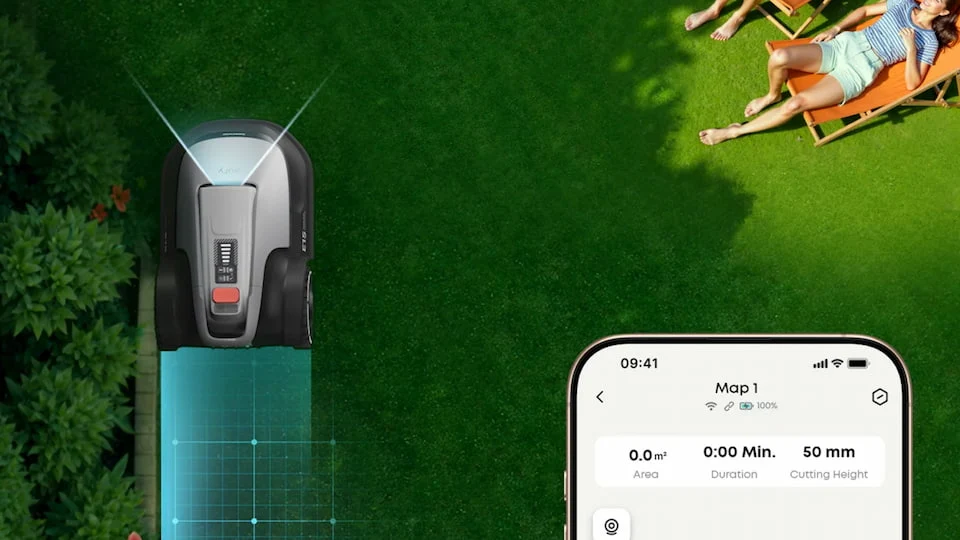
Anker's Eufy brand and Mammotion both used IFA 2026 to announce robot lawn mowers that go beyond autonomous cutting, adding edge trimming and obstacle-aware navigation. The goal: push the category closer to replacing manual lawn care entirely.
Eufy Robot Lawn Mower S2 Max
The Eufy Robot Lawn Mower S2 Max pairs a dual-blade mowing system with an extendable trimming arm that cuts right to the lawn's edge (The Verge; CNET). Navigation uses vSLAM — a technique where built-in cameras scan the yard and build a 3D map in real time, letting the mower figure out where it is without buried boundary wires or a GPS base station (The Verge).
The S2 Max can map and mow up to 3.7 acres and handle slopes up to 38 degrees (80 percent grade). It is all-wheel drive and will launch in European markets in May 2027 at €3,999 (The Verge; T3). No US pricing or availability was disclosed.
Mammotion Luba 4 AWD
Mammotion's Luba 4 AWD takes a different approach to the same edge-trimming problem. Instead of a dedicated trimming arm, it uses a snap-on edge-cutting attachment to trim against walls, fences, and garden borders. For navigation, it combines four cameras (front, sides, and rear), a 360-degree LiDAR sensor — which uses laser pulses to measure distances and detect obstacles — and network RTK, a correction service that improves GPS accuracy to within a few centimeters (The Verge).
The Luba 4 AWD also features independent front-wheel steering, letting it change direction without U-turns. That should reduce the uncut patches that typically appear when a mower has to turn around at the end of each row.
It ships in three models. The 3000F covers up to 0.75 acres, the 6000F up to 1.5 acres, and the 12000F up to 3 acres. The 3000F and 6000F use a dual-disc system with a 17.3-inch cutting width, while the 12000F uses three cutting discs spanning 20.9 inches. One notable gap: the 12000F does not support the edge-trimming attachment, so the largest-capacity model lacks the feature that sets this generation apart (The Verge). Mammotion plans to open preorders later in 2026 but has not yet shared pricing.
Two Philosophies on Navigation
The two products sit at different points on the navigation spectrum. Eufy's S2 Max goes all-in on camera-based vSLAM, dropping both boundary wires and RTK entirely. Mammotion layers cameras and LiDAR on top of network RTK, hedging against the limitations any single sensing method brings. Eufy's existing E18, announced earlier, already used a no-wire, no-RTK approach with app-based path planning and 3D obstacle detection for smaller yards up to 0.3 acre (eufy), and the S2 Max scales that architecture to substantially larger properties.
The edge-trimming capability is the shared thread. Previous-generation robot mowers, including Eufy's own E15 and E18, left perimeter strips that owners still had to cut manually with a string trimmer. Both the S2 Max's extendable arm and the Luba 4 AWD's edge-cutting attachment target that gap directly. The fact that two competing manufacturers arrived at IFA 2026 with different mechanical solutions to the same problem suggests the category has identified edge finishing as the next meaningful differentiator after autonomous navigation became table stakes.
The pricing gap between the two is not yet comparable, since Mammotion has not released figures. But Eufy's €3,999 positions the S2 Max firmly in the premium tier of consumer lawn equipment, well above the cost of a traditional ride-on mower for many mid-size properties.
What remains unresolved is how camera-only vSLAM performs in the conditions that stress vision systems most: low light, heavy rain, and yards with dense tree cover that disrupts the visual landmarks a SLAM system relies on. Mammotion's decision to retain RTK alongside its camera and LiDAR stack may reflect a deliberate hedge against exactly those failure modes. Until independent field testing covers a full mowing season across varied conditions, buyers are weighing architectural promises against real-world edge cases that robotic lawn care has not yet fully solved.
The broader trajectory is clear enough. Each generation of robot mowers has shed a manual prerequisite: first the boundary wire, then the RTK base station, now the post-mow string-trim pass. The category is converging on a product that handles a lawn end to end without human intervention beyond initial setup. The S2 Max and Luba 4 AWD are steps in that direction, not the endpoint, but they narrow the gap considerably.