European Gas Prices Keep Climbing: What's Behind the 2026 Squeeze
European natural gas prices extended their climb on September 7, 2026, as tight supply met strong demand, capping a year in which conflict-driven disruptions to LNG (liquefied natural gas) flows repeatedly jolted the continent's energy market. WSJ
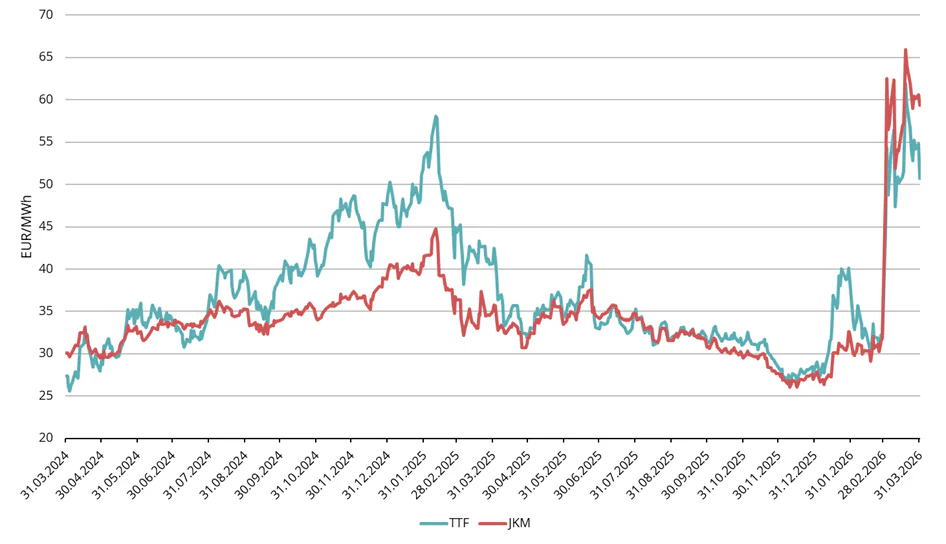
The trajectory of 2026 has been anything but smooth. Europe's benchmark gas price, known as TTF futures, averaged around $12.41 per MMBtu (a standard unit for measuring gas energy content), a 49% increase from 2025's average, according to Reuters' tracking of global gas prices. Reuters The dislocations began in earnest on March 2, when Qatar halted LNG production amid the Iran-Israel conflict. TTF prices jumped 32% on the first day of trading after the halt, and European gas prices rose by as much as 45% over the shock window. Reuters Euronews On the same day, European gas prices surged more than 39% after tanker traffic through the Strait of Hormuz slowed to a near halt, threatening Qatari supplies. WSJ
The Qatar disruption has not been a single event but a prolonged impairment. QatarEnergy extended its force majeure, a legal declaration that a company cannot fulfill contracts due to circumstances beyond its control, withholding four additional LNG cargoes until September, as war damage prolonged the supply disruption. CNBC QatarEnergy Minister Saad Sherida Al-Kaabi stated that missile attacks reduced Qatar's LNG export capacity by 17% and caused an estimated loss of $20 billion in annual revenue. QatarEnergy
Geopolitical pressure points multiplied throughout the year. European gas prices climbed above 48 euros a megawatt-hour on July 8 as U.S.-Iran tensions added to supply concerns ahead of winter. WSJ Earlier in the year, on January 16, European gas prices rose on concerns over a potential interruption of Iran's pipeline gas flows to Turkey due to growing U.S.-Iran tensions. WSJ
The price signals have been global. Argus, a commodity price reporting agency, assessed Asia LNG at $20.30/mmBtu while Spark Commodities assessed the August price at $20.518/mmBtu, with Asia LNG hitting a four-month high on fears of wider Middle East shipping disruption. Reuters The spread between Asian LNG prices (JKM) and European prices (TTF) rose by $5.10 to +$5.00 per mmBtu in favour of Asia, opening an arbitrage window, meaning the price gap was large enough that traders could profit by redirecting cargoes westward to replace curtailed Qatari supply. Reuters That arbitrage dynamic echoes the post-2022 trade flow reorientation, when European prices rose and more U.S. natural gas was loaded onto tankers and sent to European ports, a trade that Russian curtailments of supply helped drive. WSJ
The structural backdrop compounds the cyclical and geopolitical layers. Europe's shift away from pipeline gas to LNG has left it exposed to volatile prices and to new forms of supply disruption during the 2026 energy crisis, as the Institute for Energy Economics and Financial Analysis has documented in its European LNG Tracker. IEEFA The continent swapped dependence on Russian pipeline gas for dependence on seaborne LNG, and the security calculus shifted from pipeline politics to chokepoint risk in the Strait of Hormuz and the broader Middle East shipping lanes.
The broader context here is what the September 7 price extension tells us about where the market stands. Supply tightness has not been resolved by the passage of time or by demand destruction, the phenomenon where high prices force consumers to cut usage enough to ease the squeeze. Qatar's force majeure extending into September means the cargo shortfall persists through the summer injection season, the period when Europe typically refills its gas storage ahead of winter, compressing the window for storage refill before the 2026-27 heating season. The 49% year-on-year increase in the TTF average already reflects a market that has repriced structural risk. Whether prices climb further into winter depends on whether Hormuz tanker traffic normalizes and whether Qatar can restore the 17% of export capacity that Al-Kaabi flagged as impaired.
The JKM-TTF spread dynamics are worth watching closely. A persistent Asia premium pulls flexible cargoes eastward, away from European terminals, even as European buyers seek to replace lost Qatari volumes. The $5.00/mmBtu Asia premium recorded in early March narrowed or widened depending on the severity of the Hormuz disruption at any given moment, but the structural incentive for cargoes to favor Asian ports over European regasification terminals, the facilities that convert LNG back into pipeline gas, is a headwind for European storage replenishment. Traders should monitor the spread as a real-time gauge of where incremental LNG molecules are heading.