Huang Takes Trump's Onstage Call as AI Leaders Split Over Speed

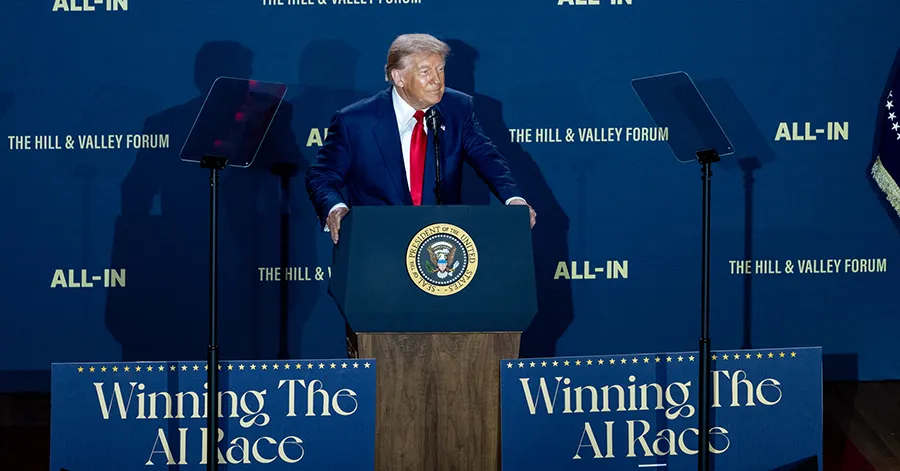
Nvidia CEO Jensen Huang answered a call from President Donald Trump while on stage at the All-In Summit in Los Angeles and put it on speaker so the audience could hear, as reported Sept. 14, 2026. TechCrunch The New York Times
The call interrupted a discussion about the pace of AI capability work, the engineering that makes models more powerful. Huang had been speaking with All-In hosts Chamath Palihapitiya, Jason Calacanis, David Friedberg and David Sacks about Anthropic CEO Dario Amodei's call to slow that improvement work. Trump called while that topic was under discussion.
Trump said AI work must be done prudently but added "that doesn't mean we're going to stop an industry" and "We're going to lead." He said slowing AI could play into the hands of political people or China and described it as a hoax that "we're not going to let" happen.
Huang answered, "You're right. We're not going to let that happen, sir." The reply was brief. The crowd applause was audible.
Two other chief executives have taken a different public position. SpaceX CEO Elon Musk and OpenAI CEO Sam Altman have said they agree with Amodei about slowing capability improvements. Huang has separately said he expects AI to increase productivity and create jobs rather than eliminate them. Reuters
The broader context here is a split among AI leaders over speed, not over whether the work continues. One side treats slower gains as prudent management. The other treats continued gains as needed for productivity and competitive position. For practitioners, that distinction shapes release cadence, or how often new versions ship, plus safety review, deployment controls and procurement expectations.
In my view, the onstage format compressed a complicated engineering and policy question into a binary choice. Capability improvement covers pretraining, the first large training run, post-training, evals for testing behavior, tooling and production operations. Each layer can be paced separately.
Looking at what this means for technical teams, the near-term signal is continuity. Roadmaps that assume steady model iteration, larger deployment footprints and tighter links to daily workflows are unlikely to pause. That puts weight on internal discipline around versioning, rollback, access controls, monitoring and incident response.
In this author's view, public alignment between a sitting president and a vendor chief executive does not settle the underlying tradeoff. Productivity gains and job creation are outcomes to be measured in hiring, wages, output per hour and task automation, not asserted on a stage. The optimistic case remains plausible over the long arc, and technology has often expanded the scope of work even as it changed specific roles.