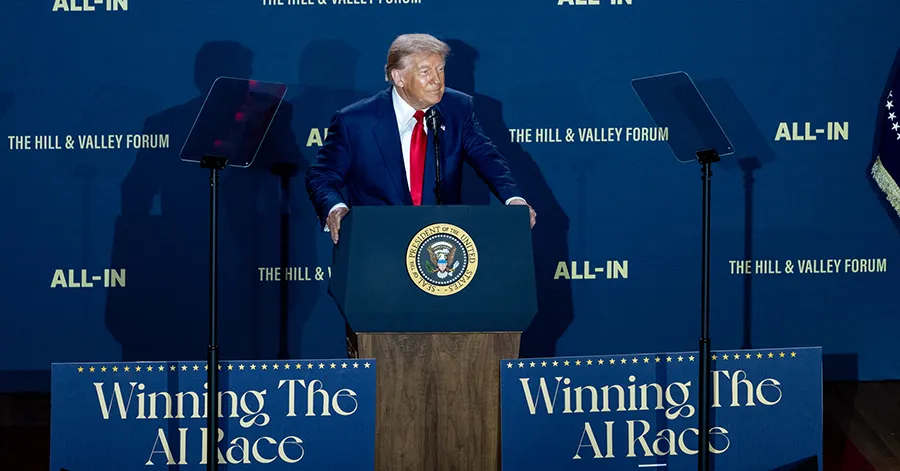
Trump Called Huang Live on Stage, on an Unreleased Foldable iPhone

Nvidia chief executive Jensen Huang took a live call from President Trump on stage at the All-In conference in Los Angeles on Sept 14. He put Trump on speakerphone for the room, and the audience heard it in real time TechCrunch.
Trump kept his remarks brief and addressed them to Huang and the audience together. He criticized the push to slow AI development, called fears about AI a "hoax," and said AI is "bigger than the internet" Yahoo Finance.
Huang took the call on Apple's new foldable phone. The $1,999 device was still five weeks from reaching stores as of Sept 14 TechCrunch. Unreleased hardware therefore carried a live presidential call in front of a technical audience.
The broader context here is speed against caution. Teams building AI models, test suites that check model behavior, supporting software that lets agents take steps, and safety controls for live use have balanced fast shipping against careful review. A statement favoring speed does not change any law or contract. It does change planning assumptions. Roadmaps get pulled forward. Safety reviews get checked for delay. Legal and policy staff get asked to justify friction in releases. Infrastructure owners read the same signal as permission to buy, provision and scale.
There is history behind that response. We have seen this pattern before, when personal computers and later cloud software spread. Tools improve. Layers of software that hide complexity get thicker. Distribution widens. Safety work shifts from blocking review before launch to steady monitoring after launch, with deliberate attack testing in parallel with deployment, rollback plans and staged releases. For company architects and platform teams, the practical question is not whether to add controls, but where to place them so work still moves fast. Language from leaders that rewards pace tends to push controls into automation, into the automated checks that run when code is submitted, and into rules enforced while software runs, rather than into committee approvals.
Looking at what this means for phone builders, the handset matters as much as the dialogue. A $1,999 foldable still five weeks from retail handled speakerphone audio cleanly enough for a stage call with no visible failure. That is a narrow observation. It still gives mobile developers useful information. A folding screen changes layout, windowing, multitasking and input assumptions. Showing unreleased hardware in public forces early work on interfaces that adapt to different screen sizes, on saving state when the phone is folded or unfolded, and on testing across many devices that already strains teams.
In my view, both threads point in the same direction. Chip supply, model ability and client hardware are moving to support assistants that are more general and more persistent, and political leadership currently wants that movement faster rather than slower. There are real failure modes in that combination, from AI making up facts in high-stakes work to agents given too much permission across systems. Those risks can be handled by disciplined teams. Better monitoring, tighter limits on what tools an agent can use, and clear human approval for actions that cannot be undone: none of that requires freezing progress.
Stepping back from the event itself, the call will fade quickly. The pattern it captures will not. Builders will keep absorbing new hardware and new policy signals, and keep shipping. The optimistic case, and the one supported over the long arc of personal computing and networked software, is that faster iteration with competent safety controls produces more useful systems for more people.