EU Gas at 82.40 Euros: Small Dip After 75% Summer Climb

EU natural gas fell to 82.40 EUR/MWh on September 15, 2026, down 0.20% on the day. EUR/MWh means euros per megawatt-hour, the standard unit for pricing power and gas in Europe. The one-month change was up 33.42%, according to pricing data cited by Trading Economics.
That daily dip sits inside a larger summer repricing. Spot prices for natural gas in Europe rose 75% since the end of June, as reported by The Wall Street Journal on September 9, 2026. The Journal's coverage titled 'European Gas Price Rises as Market Remains Tight' frames the move as a tight-market rally, per The Wall Street Journal. For households, that kind of wholesale jump can feed into heating and power bills with a lag.
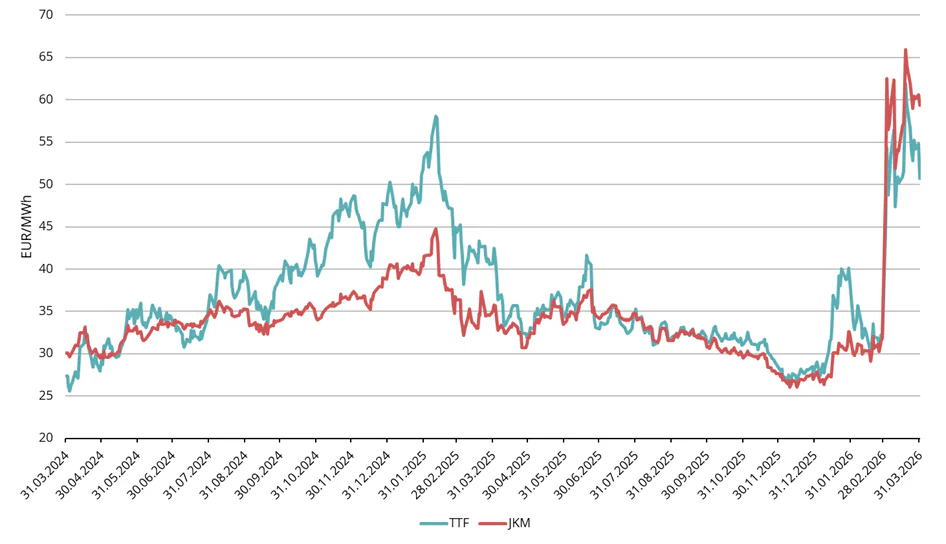
The run-up came in stages. In January, European natural-gas prices surged on expected cold weather lifting heating demand combined with low inventories, as reported by The Wall Street Journal on January 16, 2026. In March, Europe's benchmark prices surged more than 39% after tanker traffic through the Strait of Hormuz slowed to a near halt, as reported by The Wall Street Journal on March 2, 2026. The Strait is a narrow shipping lane for gas from Qatar.
Dutch TTF, the Dutch hub used as Europe's benchmark price, showed that swing. In March 2026, prices at the hub had risen to 74 euros per megawatt hour. By May, the market had cooled. Prices were hovering around 50 euros per megawatt hour, as reported on May 21, 2026, and around 46 euros per megawatt hour as reported on May 26, 2026, according to Reuters and Reuters. The June-to-September leg reversed that spring fall. TTF roughly doubled from the mid-40s to above 82 euros.
The futures curve, which plots prices for future delivery months, still shows winter costing more than spring. ICE pricing data listed Dutch TTF Natural Gas Futures for March 2027 at 74.205 and for April 2027 at 59.805 on September 9, 2026, per ICE. Contract settlement is the end-of-day settlement price on the last trading day, per ICE. ICE Endex has published a circular titled Introduction of Tiered Price Limits for Dutch TTF Natural Gas Futures, per ICE.
Market rules still shape trading. EU countries agreed to trigger a gas price cap if prices exceed 180 euros per megawatt hour for three days on the Dutch Title Transfer Facility, according to Reuters. The system was later extended to all EU hubs, according to Reuters. ICE has stated that TTF futures contracts on ICE Futures Europe will mirror those on ICE Endex but will not be subject to the MCM Regulation, per ICE. TTF liquidity itself has scaled. ICE TTF futures and options traded a record 103 million contracts through 2025, per ICE.
For comparison, in 2022, Dutch TTF gas prices swung between a low of $23 per million British thermal units and a high of $89.3 per million British thermal units in August, according to Reuters. Current spot near 82.40 EUR/MWh sits well below the 180 EUR/MWh Market Correction Mechanism trigger, but well above the 46 to 50 EUR/MWh range seen in May.
The broader context here is what trading desks will watch next. A 75% spot move since end-June followed by a 33.42% one-month gain into mid-September points to momentum with brief reversals, like the 0.20% dip on September 15. The March-to-April 2027 spread, about 14.4 euros between the two ICE prints, reflects seasonal tightness and storage economics rather than flat supply. High contract turnover gives room to warehouse that risk, but the split between MCM-exposed Endex contracts and non-MCM ICE Futures Europe equivalents, plus tiered price limits, means stop levels, margin calls, and forced rolls can behave differently across venues. In my view, the issue is less about the 82.40 level itself and more about how quickly positions can be funded and rolled if weather or Hormuz flows shock prompt prices again.