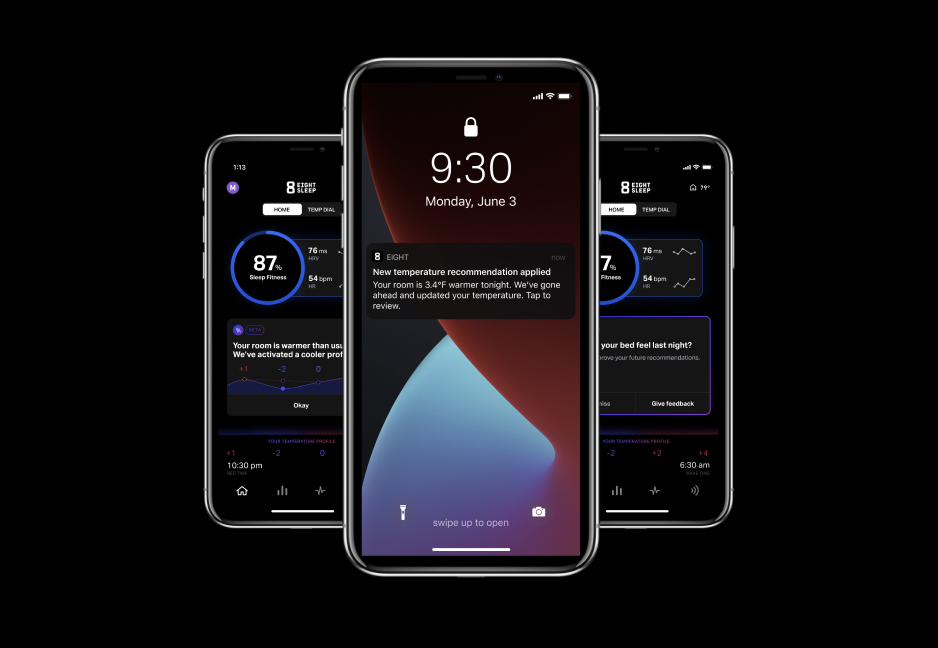
Eight Sleep Pod 6 Turns Sleep Data Into Temperature Control

Eight Sleep has announced the Pod 6 intelligent sleep system, a bed cover that regulates temperature in response to tracked health and sleep metrics including breathing rate and heart rate The Verge. The company describes it as its most significant hardware launch to date.
The hardware centers on a redesigned cooling hub. It is half the size of previous versions and small enough to hide beneath most beds. Eight Sleep says it makes temperature adjustments 20 percent faster. The hub circulates temperature-controlled water through the mattress cover, with a single hub powering regulation for both sleepers The Verge.
Pod 6 increases biometric sensors to 18, compared with two sensors in Pod 5. The system tracks heart rate, heart rate variability, breathing rate, sleep stages, and snoring for two individuals. Heart rate variability, or HRV, is the small variation in time between heartbeats and is often used as a recovery signal. It can distinguish between adults, children, and pets. Temperature control is handled by AI-powered Autopilot, which makes automatic adjustments through the night based on those signals The Verge.
Control remains app-centric. The Pod 6 app lets users set temperature, sync fitness apps, and view health insights. Each side can be cooled or heated independently, from 12°C to 43°C, like separate climate zones in a car. The Pod starts cooling or heating the bed an hour before the user's set bedtime, and the company lists the cover as working with any mattress Eight Sleep. The thermal engine is described as delivering quicker relief from hot flashes, night sweats, or chills, and the system is listed as reducing snoring. Pod 6 is also compatible with Eight Sleep's $999 cooling pillow cover accessory.
Pricing splits across configurations and regions. Pod 6 Standard ranges from $2,699 for full-size to $2,999 for king and California king sizes. A Pod 6 Solo option costs $1,999, with a cover that fits half of any size mattress for single sleepers. All configurations require a mandatory subscription ranging from $199 to $399 per year for two sleepers. The system is available through Eight Sleep's online store The Verge. In the EU, Eight Sleep lists Pod 6 starting at €2,199, with Solo sizes for EU Single mattresses or for one side of an EU Super King Eight Sleep.
The broader context here is a shift from passive measurement to actuation. Most sleep trackers report HRV, staging, and respiratory rate after the fact. Pod 6 uses those same channels as inputs for real-time thermal control. That is a harder engineering problem than logging. It requires stable heartbeat vibration signals through a water-filled cover, per-side thermal isolation so one sleeper's setting does not leak to the other, and control logic that responds without waking the sleeper. The jump from two to 18 sensors points to better spatial resolution and motion rejection, particularly for two-sleeper beds with pets or children present.
In my view, worth flagging for device-minded readers are the trade-offs. A smaller, faster hub hidden under the bed improves industrial design and bedroom acceptance. It also concentrates fluidics, thermoelectrics, and radios in a constrained thermal envelope. Mandatory subscription pricing keeps the upfront hardware cost below the $5,849 starting price listed for the Pod 5 Ultra last year, but it ties core Autopilot behavior to recurring payment. For buyers, the question is not sensor count alone. It is reliability of nightly control, data portability to fitness platforms, and how the system behaves when signals degrade. If Eight Sleep gets that loop right, sleep becomes another controllable input to recovery, alongside training load and temperature. That would be a practical gain, and practical gains are often what last.