Airbnb Adds Conversational Search and Maps Built From Friends' Trips

Airbnb has added an AI search toggle for text or voice prompts and a map built from the past and upcoming trips of a user's connections, as part of its fall product update. TechCrunch
The toggle shifts the starting point from structured filters to natural language. Users can describe a trip in a sentence or speak it aloud, much like briefing a travel agent. The system returns matching properties and sets dynamic filters based on inferred preferences. It also surfaces relevant features for each property, so users do not have to open the full listing.
That filtering is contextual. Typing "baby" brings up further filters for cribs, playgrounds, or children's books and toys. Underneath is intent parsing, where the software translates plain words into structured data, using inventory details, amenity tags, and review text. The same AI layer powers wishlist comparison, writing summaries and condensed reviews so users can weigh saved properties side by side.
Summarized reviews save time but compress nuance. Airbnb keeps that comparison inside the wishlist, where the candidate set is already curated by the user.
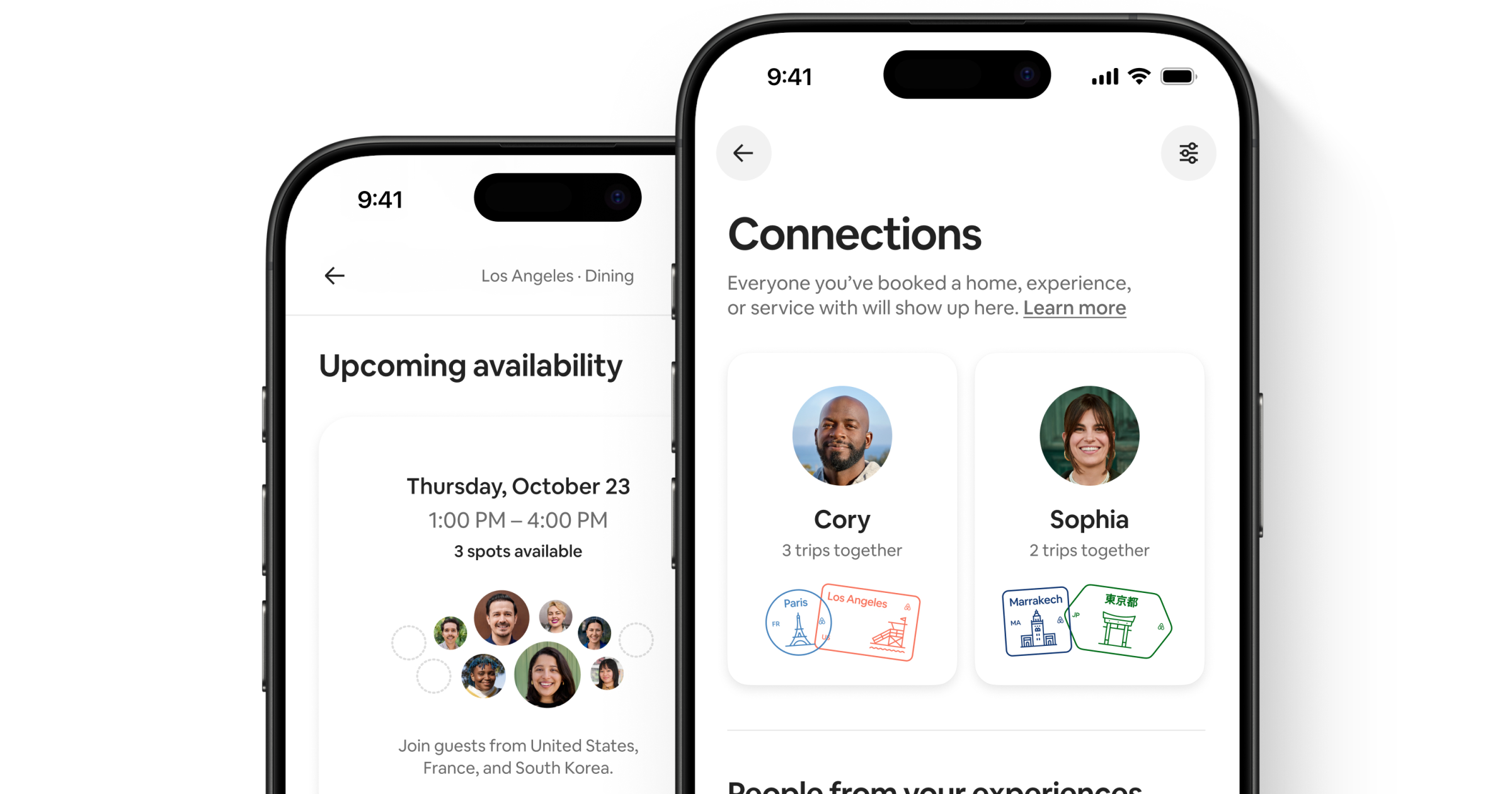
Social graph as a discovery layer
Users can add friends and family as connections to populate a travel map. The map shows where those contacts have been and where they are going next. TechCrunch
Tapping a connection's trip shows where that person stayed and which experiences they booked. The map acts as a recommendation feed based on first-degree relationships, meaning direct contacts, rather than aggregate ratings or algorithmic picks.
Airbnb provides an option to not share trips with others. Privacy is opt-out per trip, not an account-wide default described in the release. That design keeps the network dense while giving travelers control over specific itineraries.
Airbnb is also building neighborhood pages based on guest reviews and other sources to help travelers find places to eat and things to do. The pages are not yet positioned as guides authored by hosts or editors. They read as synthesized local context, assembled from the review corpus, meaning the large body of past reviews.
The social push extends to bookable activities. The features promote additional experiences such as food tastings and craft workshops, with discovery tied to what connections have done. For Airbnb Experiences, maps let users filter for nearby landmarks, attractions, restaurants and more, a function introduced for Experiences in October 2025. Airbnb
Services expansion continues
The fall update adds baby gear rental, laundry services and meal delivery services to the app, plus ski and boat rental in limited locations. Grocery delivery, introduced earlier, expands under the same update.
This continues a services strategy laid out in the 2026 Summer Release, which introduced airport pickups, boutique hotels and car rentals. Airbnb That release paired new Airbnb Services with $0 delivery fees and $10 off orders of $50 or more, as described in May 2026. Airbnb
The link from search to services is direct. A conversational query that captures party makeup or trip intent can route to a relevant add-on. Family travel triggers crib filters and a baby gear offer. A ski trip triggers equipment rental where available.
Airbnb said in November 2025 that it was building AI-powered search to let people have a conversation with the app. Airbnb The fall toggle is the shipped form of that plan.
The broader context here is a shift in how travel platforms handle query specificity. Keyword search and faceted filters, meaning checkbox-style categories, assume users know how inventory is organized. Prompt-based search assumes they do not, and that the system should bridge everyday language to structured attributes. The engineering challenge is recall and precision at once, matching vague prompts without flooding results or overfiltering to zero.
In my view, the social map may matter more than the search box over time. I have watched my own children ignore five-star averages in favor of a single message from a friend who stayed somewhere. That behavior scales. A connection graph is sparse compared with the review corpus, but each edge carries higher weight. Worth flagging is the tradeoff. Social discovery improves conversion, meaning bookings, when the graph is active and degrades into an empty state when it is not. Privacy controls, onboarding prompts, and the ability to get value before adding many contacts will decide adoption.
Looking at what this means for operators, Airbnb is assembling a bundled trip stack of stay, movement, food, and in-stay services under one query interface. The long arc favors that integration. Travel planning has always been fragmented across tabs and apps, and any reduction in that overhead tends to persist once users trust it.