Nvidia Puts AI Agents on PCs and in the Enterprise in One Release
Nvidia launched new open-weight models for always-on agents and edge computing on Oct. 19, splitting the release between models that run locally on PCs and a larger model for enterprise agents. TechCrunch
Open-weight means the trained model files are openly available for developers to download and run. The local side consists of two lightweight Bolt models built to run on AI PCs powered by the Nvidia RTX Spark chip and on workstations running DGX Spark.
The larger local model is Nemotron 3.5 Bolt 74B-A9B 24GB, a 74-billion-parameter model for local agentic tasks including multistep reasoning, or working through a task in steps, tool calling, or using external software, and web browsing. The smallest Bolt model, Bolt E4B, is aimed at conversational agents. Nvidia is claiming that full loop of reasoning, tool use and browsing can now stay on device.
The enterprise side is Nemotron 3.5 Super VL, a 120-billion-parameter model geared for enterprise agents. Nvidia said Super VL is being used by Skydance, EY, Ramp, CrowdStrike, Perplexity and Salesforce. Kari Briski is Nvidia's vice president of Open Models and Software, the organization behind the release.
Hardware timing is tightly coupled. NVIDIA RTX Spark preorders opened Friday, Oct. 16, according to Nvidia. DGX Station for Windows brings GB300 AI infrastructure to the enterprise desktop. Nvidia Spark covers the AI PC entry point, while DGX Spark and DGX Station cover workstation and desktop infrastructure for larger local workloads.
The software scaffolding around the models was already in place. NVIDIA Agent Toolkit provides open source models and software for enterprises and developers building tools that scale productivity. NVIDIA offers the AI-Q open agent blueprint for developers to create custom AI agents that can perceive, reason and act on enterprise knowledge. Nvidia
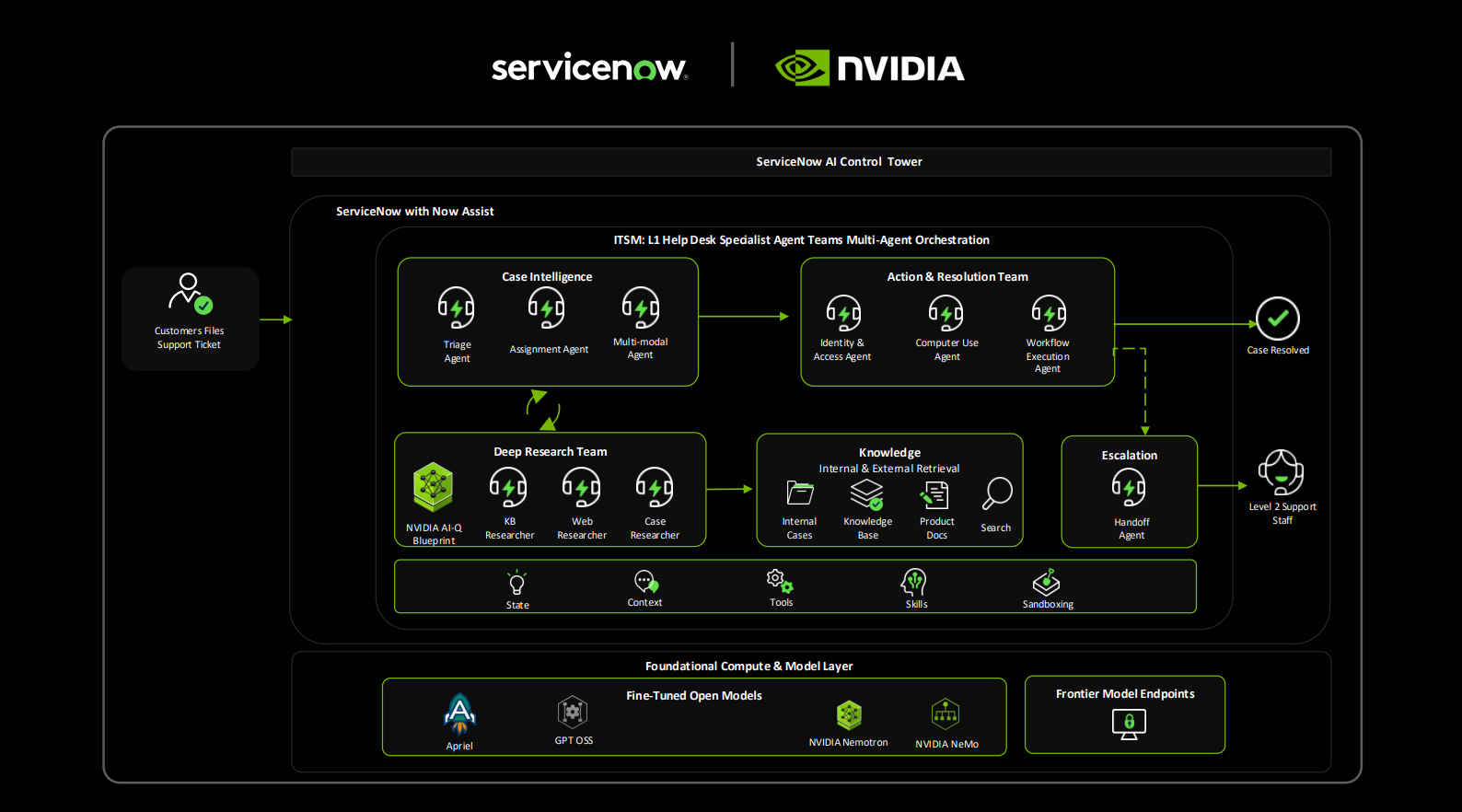
Security and prior model work add further context. NVIDIA announced the NVIDIA Open Agent Safety Platform, an open software platform and reference system design to strengthen AI security. Nvidia NVIDIA previously unveiled new open models and datasets for always-on agents, including Nemotron 3 Ultra, a smaller, faster open model built for long-running agents. NVIDIA states Nemotron 3 Ultra delivers 5x faster inference, or faster generation of answers. ServiceNow uses Llama Nemotron models to build AI agents for enterprise productivity, and its ServiceNow AI Platform uses closed and open models, including Apriel models and NVIDIA Nemotron.
Looking at deployment, the shift is architectural rather than only about model size. Centralized agent setups kept tool use, memory and policy checks in the cloud. Moving multistep reasoning and browsing into a 74-billion-parameter local model, with dialogue in an even smaller model, reverses that setup for tasks where delay or data sensitivity matters.
In my view, that reversal will be tested less on benchmarks than on sustained operation. Always-on implies long context retention, background tool invocation, power management and safe failure modes. Worth flagging for enterprise teams is that local execution eases data movement concerns but pushes monitoring, access control and update discipline to the endpoint fleet. The Open Agent Safety Platform and blueprints like AI-Q read as acknowledgment of that trade.
The broader context here is familiar from prior platform transitions, when heavy work moved close to the user while staying connected to central systems. My kids grew up toggling between cloud apps and on-device apps without thinking about the boundary, and enterprise users will do the same with agents. If the integration holds, what this enables is a consistent Nemotron path from E4B for dialogue, through Bolt 74B for local agency, to Super VL for heavier enterprise work, with Spark hardware as a local target.