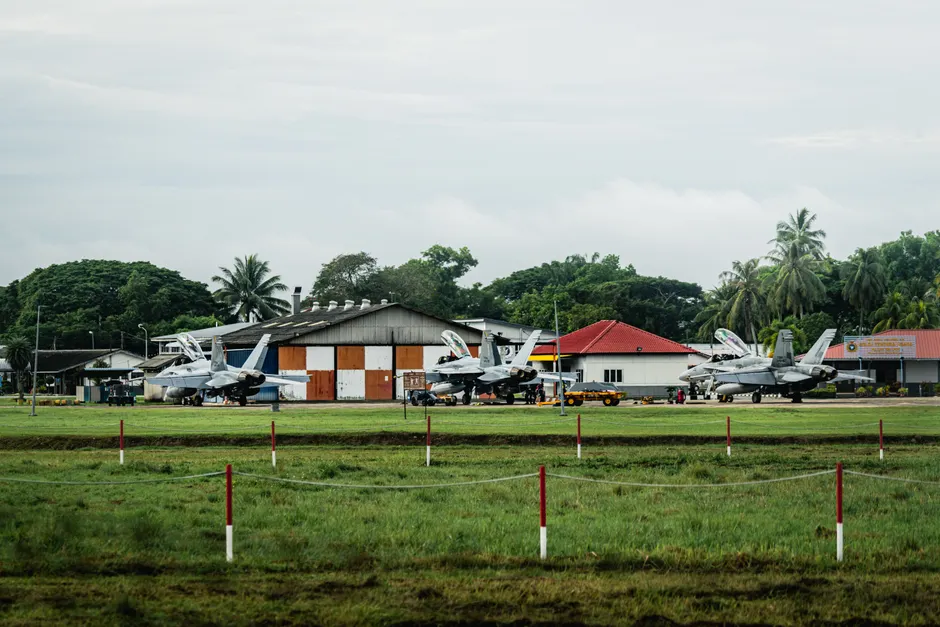
Iran Escalates Strikes on U.S. Bases Across the Gulf

Iran's Islamic Revolutionary Guard Corps (IRGC) launched waves of missiles and drones against U.S. military bases in Bahrain, Jordan, Kuwait, and other Gulf states on July 13, declaring it retaliation for American strikes on Iranian territory. The scope and coordination of the attack signal a sharp widening of the conflict beyond the earlier skirmishes reported in June.
According to Iran's own accounts, the IRGC struck U.S. military infrastructure in Juffair, Bahrain, hitting facilities at Sheikh Isa Air Base. In Jordan, it claimed missiles and drones destroyed fuel depots and ammunition storage at Prince Hassan Air Base. In Kuwait, the IRGC said it destroyed HIMARS launchers—long-range weapons systems—and missile warehouses. The Guard also reported hitting radar installations in Oman that track vessels and aircraft in the approaches to the Strait of Hormuz, the narrow waterway through which roughly one-third of global seaborne oil passes.
Host nations confirmed they responded to the attacks but did not validate Iran's specific damage claims. Jordan's military said it shot down four missiles that crossed into its airspace. Kuwait reported its air defense systems engaged hostile targets. Bahrain activated civil-defense sirens and told residents to shelter in place. These measures confirm the strikes occurred but offer no independent measure of what was actually hit.
The sequence of events matters for understanding how quickly the situation has spiraled. On July 6–7, three merchant ships were attacked in the Strait of Hormuz. Iran declared the strait closed on July 7. Two days later, Iran warned that "foreigners have no stake" in the waterway. On July 8, the U.S. military resumed strikes on Iranian targets. By July 12, CENTCOM reported it had struck 140 targets inside Iran—a scale far larger than the June operations, when it said it defeated seven ballistic missiles and four one-way attack drones. On July 13 came Iran's retaliatory strikes.
What makes the July escalation different is its reach. Attacks now span Bahrain, Jordan, Kuwait, Oman, and Qatar—pulling in U.S. military partnerships across most of the Gulf Cooperation Council, the regional alliance of Gulf monarchies. This is not a contained bilateral exchange but a widening engagement with consequences for the entire region and global shipping.
The broader picture here reveals a collapsed framework. In April, the Trump administration announced it had ordered a naval blockade to counter Iranian aggression and keep Hormuz open. By June, the White House claimed a bilateral memorandum of understanding with Iran had "fully reopened" the strait. The gap between that claim and July's mutual strikes, tanker attacks, and closure declarations shows that whatever understanding existed has broken down.
On the question of whether the strait is actually closed, both sides have made incompatible claims. The Persian Gulf Strait Authority stated transit was "not possible" due to U.S. actions. President Trump asserted on NBC's Meet the Press that the strait remains open. Resolving this contradiction requires independent data on shipping volumes and insurance costs—metrics that typically lag official statements by days. Until those figures arrive, we are working with dueling assertions rather than hard evidence.
Central to what happens next is how host governments behave. Manama, Amman, and Kuwait City have watched U.S. strikes expand to 140 targets. The public stance each capital takes—whether toward de-escalation or toward matching U.S. posture—may shape the speed at which the conflict continues or stabilizes. Their role is less about direct military power than about signaling to their populations and to Iran whether this region is tilting toward sustained confrontation or a negotiated settlement.