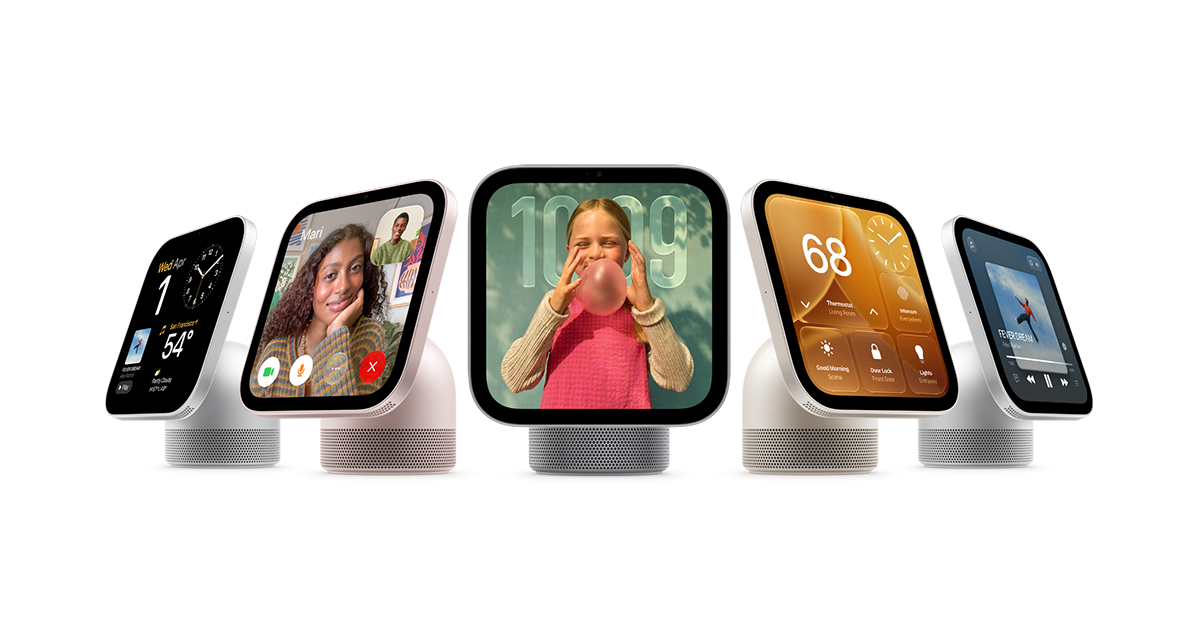
Apple HomeView Audio Tested: Close to a HomePod Mini 2, but No Stereo Pairing

The Verge has published follow-up testing of the audio on Apple HomeView, the company's first smart display, along with its support for third-party music apps. The piece, dated 22 November 2026, was written to answer reader questions that followed the outlet's original HomeView review.
The tabletop model uses two drivers in its display, plus a woofer and two passive radiators (bass-extending diaphragms with no motor of their own) in its base. The HomePod Mini 2 has a single full-range driver and two passive radiators. Based on the testing, the tabletop HomeView sounds comparable to the HomePod Mini 2. It delivers better bass and is slightly louder, but it offers less clarity and less room-filling sound.
The display adds two features the HomePod Mini 2 lacks. HomeView supports Spatial Audio with Dolby Atmos, a format that places sound in three dimensions rather than on fixed channels. Apple also added an accelerometer, a motion sensor that detects orientation, so the display adjusts its EQ (equalization, the balance of frequencies) in real time based on tilt angle. The change matters most when the unit is moved or angled on a desk, since the tuning follows orientation rather than assuming a fixed position.
The wall-mounted version has only two drivers. Its computational audio, which shapes the sound in software, is tuned for on-wall placement. The two models are therefore not interchangeable in acoustic design. A buyer choosing between mounting options is choosing between two separate tuning profiles, not a single speaker that can be placed either way.
Multi-unit behavior is more restricted. Two Apple HomeView units cannot be paired for stereo sound, and a HomeView cannot be stereo-paired with a HomePod or HomePod Mini. Stereo separation is unavailable across any combination of Apple's current speakers and displays, which limits a household that wants a stereo image in a single room.
Grouping works differently. HomeView units can be grouped with other AirPlay speakers to play music simultaneously, so a HomeView can take part in a multi-room setup even though it cannot form a stereo pair.
The broader context here is how the speaker market has long separated two roles. Stereo imaging depends on matched channels and precise placement. Multi-room synchronization depends on a shared clock and a common transport. Apple's design, as tested, keeps the second and withholds the first from HomeView. That is a product decision with clear consequences for buyers who expected a display to slot into an existing stereo setup.
The follow-up testing also covered third-party music app support, which matters for anyone whose listening runs outside Apple Music. Users who build their home audio around AirPlay routing can add the display to that routing without giving up multi-room playback.
In my view, the most useful reading of the testing is practical. HomeView is not a replacement for a dedicated stereo pair, and its audio is closer to a capable single speaker with added spatial processing. Its value rests on the screen, the tilt-aware tuning and the AirPlay grouping. Multi-room playback is likely to matter most over the long run, and buyers will judge the device on whether those features fit how they use a room.