Kyrgyzstan's President's Cup Puts Kok-Boru in the Spotlight
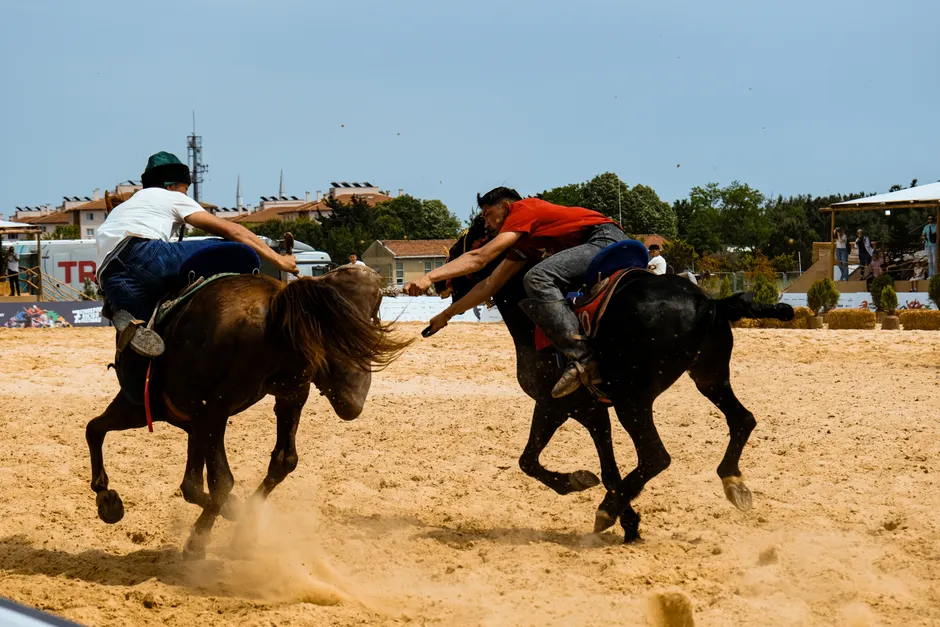
Fourteen kok-boru teams competed for the President's Cup in Cholpon-Ata, Kyrgyzstan, in July 2026, according to reporting by 24.kg (24.kg).
The tournament brought the traditional Central Asian equestrian sport to the Issyk-Kul lakeside city, a venue that has become a familiar setting for state-backed cultural and sporting events in Kyrgyzstan. The President's Cup, as the name suggests, operates under high-level state patronage. That places it within a broader pattern of governments in the region using traditional sports as tools of cultural diplomacy, meaning the deliberate use of cultural events to build influence at home and abroad, and to strengthen national identity. The 14-team field, while modest in absolute numbers, allows for a competitive round-robin or knockout format across a compact schedule.
Kok-boru, sometimes called buzkashi in neighbouring countries, involves mounted riders contesting possession of a goat or calf carcass and delivering it to a designated scoring area, typically a circle or pit at either end of a long field. Think of it as a rough analogue to polo, but with a carcass instead of a ball and far fewer restrictions on physical contact between riders. The sport has deep roots in the nomadic cultures of the Tian Shan and Pamir mountain regions and carries significant symbolic weight in post-Soviet Kyrgyz statecraft. Its inclusion in state-sponsored events works on several levels at once entertainment, heritage preservation, and a signal directed at both domestic audiences and neighbouring states where variants of the game are also played.
Cholpon-Ata, on the northern shore of Issyk-Kul, has hosted World Nomad Games events in prior years, giving it infrastructure suited to large-scale equestrian competition. The choice of venue for the President's Cup fits an established pattern of staging traditional-sport tournaments in locations that double as summer tourism destinations, linking cultural policy with economic activity in the Issyk-Kul region.
The July 2026 timing places the tournament within Kyrgyzstan's peak summer season, when domestic and regional tourism along the Issyk-Kul corridor is at its highest. This scheduling is consistent with prior state-backed cultural events that use seasonal visitor traffic to maximise attendance and visibility.
What the available reporting does not specify is the tournament's outcome, individual team rosters, or the precise competition format. The 24.kg sources, both undated, confirm the participation count and the competition's identity as the President's Cup but do not detail group standings, final results, or the specific governmental office under whose authority the event was organised (24.kg).
The broader context here is that the tournament fits within a wider regional pattern in which Central Asian governments have systematically elevated traditional nomadic sports, allocating state resources and presidential-level branding to competitions that a decade ago operated largely on community or provincial budgets. Kyrgyzstan's World Nomad Games, first held in 2014, established a template that has since been emulated and adapted across the region. The President's Cup functions as a domestic-tier extension of that framework, keeping the institutional machinery of traditional-sport promotion active between the larger multinational events.
For practitioners and federations involved in kok-boru, state-backed tournaments carry practical consequences beyond prestige. They determine access to facilities, veterinary support for horses, and prize structures that sustain professional or semi-professional participation. A 14-team field at the presidential level indicates a healthy participation rate, though the absence of international team entries in the available reporting suggests this edition remained a domestic competition rather than a regional championship.
It is also worth noting that traditional-sport patronage in Kyrgyzstan operates within a competitive regional environment. Kazakhstan, Uzbekistan, and Tajikistan have each developed their own frameworks for promoting pre-Turkic and pre-Islamic sporting traditions, often with overlapping claims to shared cultural heritage. When Kyrgyzstan hosts a President's Cup in kok-boru, it contributes to an ongoing, if informal, contest over which national federation sets the standard for a sport that predates all of the modern states in question.
The tournament in Cholpon-Ata thus sits at the intersection of cultural preservation, state branding, and regional soft-power positioning, even as the specific results and administrative details remain, at this stage, outside the public record as reported by available sources.