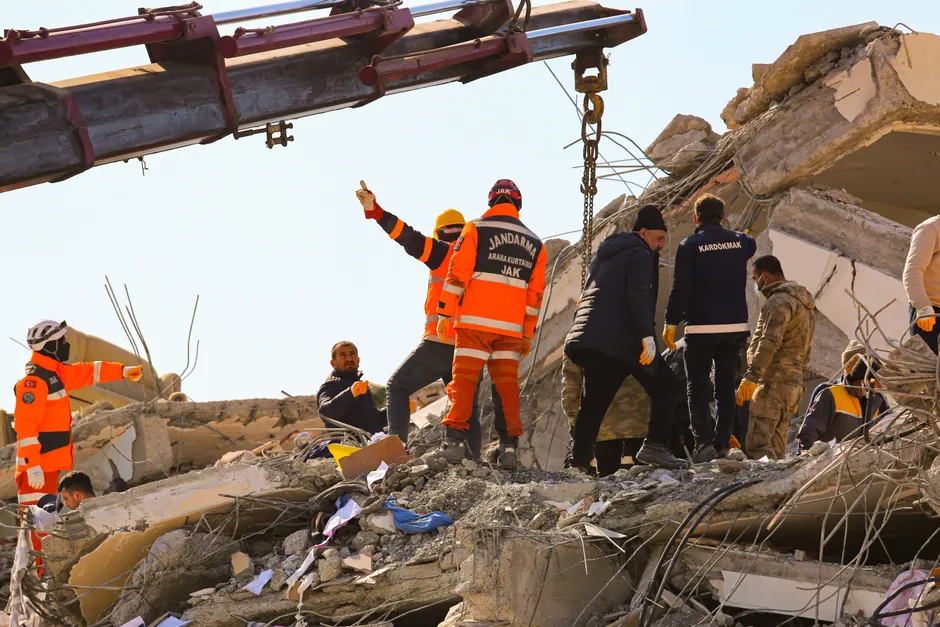
Venezuela Earthquakes Kill 235, Draw International Rescue Teams to La Guaira

Venezuela's health minister has reported approximately 235 dead and 4,300 injured following a pair of earthquakes that struck the country, with rescue teams from the United States and Germany now on the ground in the coastal city of La Guaira, AP News reported on June 26.
The back-to-back seismic events — confirmed by Secretary of State Marco Rubio as the basis for a U.S. humanitarian response — have triggered one of the more significant international search-and-rescue mobilizations to Venezuela in recent memory, a country that has spent much of the past decade largely isolated from Western emergency frameworks due to U.S. and EU sanctions and the political standoff with the Maduro government.
The Response on the Ground
Virginia Task Force 1, the FEMA-accredited urban search-and-rescue (USAR) team based in Fairfax County, has been deployed to Venezuela, WJLA reported on June 26. The unit — one of the most operationally experienced USAR teams in the U.S. federal system, with prior deployments to Haiti, Turkey, and the Bahamas — specializes in structural collapse rescue, which is precisely the skill set required when reinforced concrete fails in a densely built urban environment like La Guaira or the capital, Caracas.
Germany has also dispatched a federal disaster relief team, Reuters reported on June 25. Berlin's THW (Technisches Hilfswerk) has a long operational record in post-earthquake environments and routinely coordinates with UN OCHA under international disaster response protocols.
The convergence of U.S. and European responders in Venezuela is operationally notable. Bilateral diplomatic channels between Washington and Caracas remain severely constrained, which means coordination will likely flow through UN humanitarian architecture rather than direct government-to-government liaison — a setup that adds procedural friction during the hours that matter most in structural collapse rescues.
Casualties and Context
The 235 death toll, as reported by the Venezuelan health minister and confirmed by AP News on June 26, should be read as a floor, not a ceiling. In major seismic events with significant structural collapse, official counts in the first 48–72 hours routinely lag the actual toll as teams clear rubble and reach outlying areas. With 4,300 reported injured, the medical burden on Venezuelan hospitals — already operating under chronic shortages of supplies, personnel, and power — will be severe.
La Guaira, the port city that serves as Caracas's primary maritime and air gateway, is geographically exposed. Situated in a narrow coastal strip between the Caribbean and the Avila mountain range, it has long been identified in regional seismic hazard assessments as acutely vulnerable to both primary ground motion and secondary effects such as slope instability. The 1999 Vargas tragedy — landslides triggered by extreme rainfall in essentially the same topography — killed tens of thousands and remains the regional benchmark for catastrophic infrastructure failure in that corridor.
Venezuela's pre-existing humanitarian crisis compounds every dimension of the response. Years of economic collapse have degraded building stock, depleted national emergency stockpiles, and driven out much of the medical and engineering workforce. What would strain a well-resourced government is arriving on top of conditions that already stretched Venezuela's institutions past their limits.
The Diplomatic Dimension
Rubio's public confirmation of the U.S. response is itself a signal worth parsing. The current U.S. posture toward the Maduro government has been coercive — sanctions, diplomatic non-recognition of disputed elections, and active support for opposition figures. Humanitarian deployments to adversarial states have historically been handled with careful messaging to avoid any appearance of political normalization, while also not being withheld on political grounds when lives are at stake. Whether this deployment opens any back-channel diplomatic contact, or is deliberately walled off from political track entirely, will become clearer in the coming days.
For the specialist community managing this response: the immediate operational variables are airspace access and customs clearance for equipment, hospital surge capacity in Caracas, and the integrity of the La Guaira–Caracas highway corridor — a mountain road susceptible to earthquake-triggered rockfall that is also the primary overland supply route between the port and the capital.