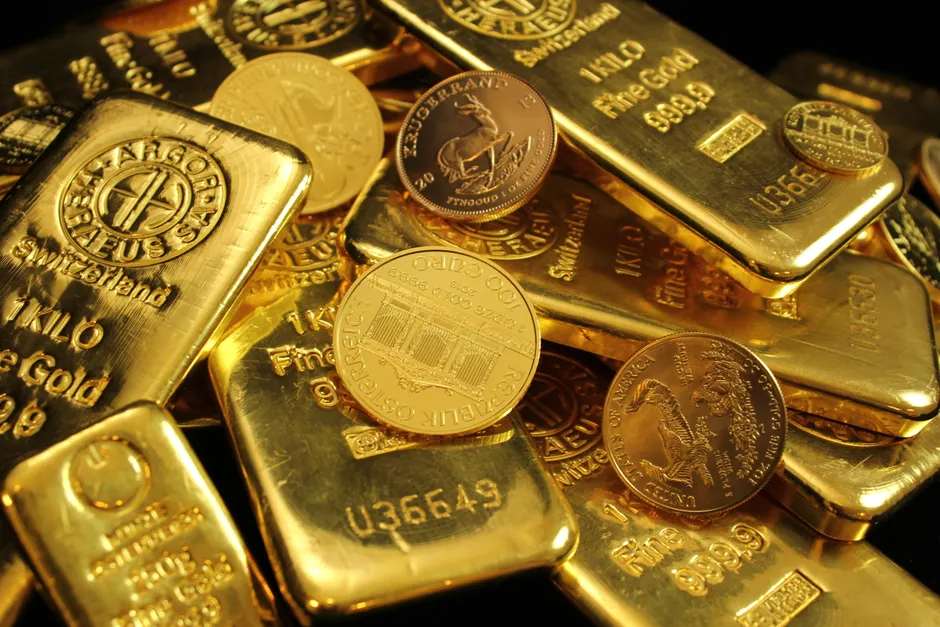
Why Gold Just Hit $4,000 — And What It Means for Your Money

Why Gold Just Hit $4,000 — And What It Means for Your Money
Gold crossed $4,000 per ounce for the first time in October 2025, according to The Wall Street Journal. That sounds like a big number. But the real story isn't the price itself — it's why gold got there, and what that tells you about the risks sitting underneath the global economy right now.
The Middle East Tension
Start with what's happening in the Middle East. In early October 2024, the U.S. Department of Defense confirmed that American military assets were actively defending Israel against Iranian missiles — not just watching from the sidelines, but directly involved. Later that month, Israel struck Iranian military targets in retaliation. The Pentagon said at the time this "should mark the end" of the back-and-forth.
It didn't. The cycle of strike and counter-strike continues. When geopolitical risk feels real and open-ended like this, investors look for safety. Gold — which doesn't depend on any government, pays no interest, and carries no credit risk — becomes attractive. Big investors and central banks bought it as insurance.
The Deeper Problem: Inflation Uncertainty
But geopolitical flare-ups alone don't usually push a commodity's price higher for years. The real driver here is uncertainty about inflation.
Russia's invasion of Ukraine in February 2022 disrupted global supplies of oil, grain, and other essentials. Prices spiked. Central banks around the world had to raise interest rates aggressively to fight inflation. Even though inflation has cooled since then, the experience left a scar. As Federal Reserve Governor Adriana Kugler noted in October 2024, we learned that when a major energy exporter is at war, supply shocks can be severe and sudden.
A Federal Reserve research note from January 2025 documented that this uncertainty hasn't gone away. Volatile commodity prices and geopolitical tensions continue to create a wide range of possible inflation outcomes — not a temporary blip, but a structural condition that looks likely to stick around.
This is where gold matters. It's not simply a bet that inflation will rise. It's a hedge against inflation uncertainty — protection against the possibility that central banks lose control of prices again, or that supply shocks return. When the range of possible outcomes widens, gold becomes more valuable as insurance. That's what you're seeing in the price.
Who Is Buying Gold?
The buying has come from three different groups, and that matters.
Central banks have been accumulating gold steadily since 2022. A big reason is what happened to Russia: the U.S. froze Russian assets after the invasion. That sent a message to every country outside the West: keeping your money in U.S. dollars might not be safe if the U.S. decides to punish you. So countries started diversifying into gold instead.
Retail investors in countries with weak currencies — China, Turkey, parts of Southeast Asia — have also been buying. When your local currency is losing value, gold feels safer than keeping cash.
Western investors — pension funds, asset managers, institutional money — have slowly rotated into gold as well. When interest rates on U.S. Treasury bonds (which had been attractive) started to fall, gold became more competitive as an investment.
These three sources of demand all pushing in the same direction is what makes $4,000 defensible as a real market assessment rather than pure hype. It doesn't mean $4,000 is a floor that won't break. It means the demand is coming from serious, structural reasons.
The Pattern Worth Understanding
I've seen gold break through big round numbers before — $1,000 during the 2008 financial crisis, $2,000 during COVID. The pattern is always the same: beforehand, the price seems crazy. Afterward, it becomes the baseline.
When gold hit $1,000 in 2008, many people called it crisis hysteria. Within ten years, $1,200 was the floor. When it crossed $2,000 in 2020, skeptics said the same thing.
What these moments share is that the price moved because something real and lasting shifted in the economic or geopolitical environment — not because of sentiment or momentum chasing. Right now, gold is dealing with simultaneous geopolitical escalation, structurally elevated inflation uncertainty, and years of central bank buying. That combination has staying power.
What the Price Chart Alone Won't Tell You
Technical analysts look at gold's chart and debate whether the uptrend continues or reverses. That framework has a limit: it can describe what happened, but it can't predict what's coming. Gold's history is full of sudden sharp reversals that happened right when the trend looked most obvious.
What matters more is whether the risks priced into gold right now are correct. The Middle East situation — American forces defending Israel, Iranian missiles, Israeli strikes inside Iran — is an open-ended threat that doesn't fit neatly into probability calculations. If escalation resumes and spreads, today's price might look cheap. If there's a durable ceasefire and supply chains stabilize, the unwind could be sharp.
The honest assessment is this: the case for holding some gold based on inflation and geopolitical risk is sound. The current price assumes the world will remain uncertain and volatile. Whether that assumption holds — only time will tell.
The Fed's Own View on Inflation Risk
Here's something worth noticing: the Federal Reserve's own researchers, in that January 2025 note, identified commodity price volatility and geopolitical tension as twin drivers of global inflation uncertainty. They're saying those risks are built into the system and likely to persist.
The Fed wouldn't say it this bluntly, but their research is telling investors: this is an environment where gold makes sense as part of a diversified portfolio.
Where We Are Now
Gold hit $4,000 because of a clear chain of events: Russia's invasion created a commodity shock, global inflation spiked, central banks raised rates, countries decided to hold less dollar reserves and more gold, and the Middle East conflict kept geopolitical risk alive and refreshed. The 27% gain in 2024 was the acceleration — things moving faster than expected.
The real question now is whether the conditions that got gold here will stick around or whether the market has already priced in years of future gains.
That question doesn't have a clean answer. The conditions are real. The price is the market's collective bet that they'll persist.