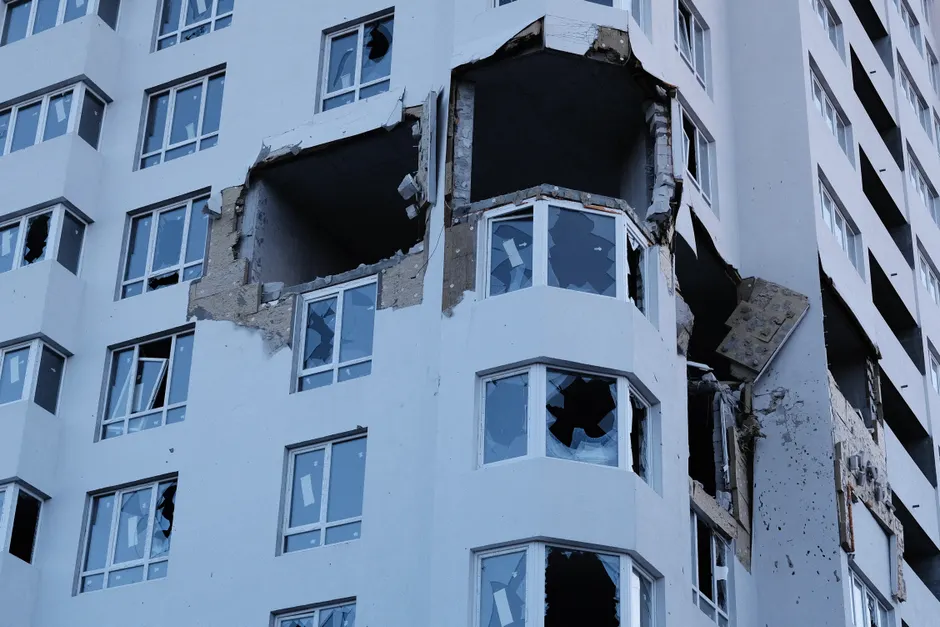
Missiles Hit a Drone Show Near Kyiv — Here's What Happened and Why It Matters

Russian missiles struck a drone technology exhibition near Kyiv on July 24, 2026, killing 10 people and injuring about 100, according to Ukrainian President Volodymyr Zelensky (BBC). The attack took place during the day at an event that had been publicly advertised. It was attended by important people in Ukraine's defence sector, including drone makers, members of Ukraine's drone forces, and security services. Russia's Defence Ministry confirmed it carried out the strike (BBC).
Ukrainian air force spokesman Yuri Ihnat said the attack involved three ballistic missiles. Ballistic missiles are weapons that fly in a high arc and travel extremely fast, making them very hard to shoot down. Only one of the three was intercepted (BBC). The strike damaged 23 houses and 34 cars in the surrounding area, Ukraine's State Emergency Service reported (antikor.info). Russia's Defence Ministry said the site was being used to demonstrate drones meant to attack civilian infrastructure inside Russia, and said high-precision long-range weapons were used (BBC).
The exhibition attack was part of a larger wave of Russian strikes across Ukraine that day. At least 15 people were killed in total: the 10 at the exhibition and five killed by Russian glide bombs in Sloviansk. Glide bombs are bombs that are dropped from a plane and then guided to their target without an engine (BBC). Two men were confirmed dead by military officials in the northern city of Sumy early the following Saturday (BBC).
The fact that the exhibition was publicly advertised drew widespread outrage inside Ukraine. President Zelensky said the incident was being investigated. Ukraine's prosecutor-general announced efforts to find out who decided to hold the event and what safety measures were in place (BBC). Defence Ministry adviser Serhiy Beskrestnov, known by his call sign Flash, and defence technology developer Lyuba Shypovych both confirmed on social media that they were unharmed. Beskrestnov said he had stayed away from the event due to security concerns (BBC).
This is at least the third time since Russia's full-scale invasion in 2022 that a drone or defence exhibition has been struck (BBC). The recurring pattern raises questions about whether it is safe to hold events that gather key defence personnel near the front lines.
The violence was not confined to the Ukrainian side. A Ukrainian strike on the Russian city of Kirov killed six people and wounded 26 on the same Friday (BBC). That evening, President Zelensky said he had received intelligence that Russia was preparing another massive missile strike, which could happen within 48 hours (BBC).
The broader picture here is that both sides are increasingly attacking what each calls legitimate military targets, with civilians frequently caught in the middle. Russia describes the exhibition as a staging ground for drone operations against Russian civilian infrastructure. Ukraine describes Russian glide bomb attacks on populated areas the same way. Both narratives are designed to frame civilian casualties as a side effect of a military objective rather than the objective itself. International humanitarian law, the set of rules that governs how wars are fought, examines each case individually to judge whether that framing holds up.
For defence-sector professionals, the lesson is straightforward: publicly advertising gatherings of drone developers and military personnel in a war zone where the other side has accurate, long-range weapons carries predictable risks. The interception rate on this attack — one of three ballistic missiles — also shows how difficult it remains for Ukrainian air defenses to stop fast-moving ballistic threats, where there are only seconds to react.
The investigation announced by the prosecutor-general will likely focus on who authorized a publicly advertised event at a location that could be discovered, and whether safety threat assessments were conducted or ignored. With Zelensky's warning of an imminent follow-on strike, the immediate concern is whether the intelligence pointing to another large-scale attack within 48 hours turns out to be accurate, and whether defenses are adjusted in time.