Oil Prices Surge as US-Iran Negotiation Window Expires Without a Deal

Brent crude, the global benchmark for oil prices, rose above $90 a barrel on 18 August 2026 for the first time since 30 July, trading at $91.63 on Tuesday morning. The spike came after a two-month window to negotiate an end to the US-Israel war on Iran expired with no agreement, and both sides hardened their positions. US West Texas Intermediate (WTI) futures — the American benchmark — were up 81 cents, and Reuters reported Brent at $91.22 by 0827 GMT on 18 August (Reuters). The two-month window to negotiate a peace deal expired on Monday 17 August with no end to the conflict in sight (The Guardian).
The military backdrop has tracked closely with the diplomatic collapse. The White House announced Operation Epic Fury on 1 March 2026, describing it as a campaign to "crush" the Iranian regime and end its nuclear threat (White House). That operation has continued through repeated rounds of strikes and several short-lived ceasefires. On 4 August, Trump offered Iran a "last chance" to make a deal, pausing US strikes while Oman — a small Gulf nation that has served as a diplomatic go-between — mediated a shipping corridor through the Strait of Hormuz (Fox News). That pause has now lapsed without a settlement.
Trump, in a phone interview with Fox News chief foreign correspondent Trey Yingst on Monday, demanded that Tehran "put up the white flag of surrender." He also said he was "not in a hurry" to reach a deal and would not impose a fresh deadline: "I have no time schedule. I'm not in a hurry." Trump confirmed the existence of a US backchannel — a secret or informal line of communication — with Iran's Islamic Revolutionary Guard Corps (IRGC), an elite branch of Iran's military, during the same interview (Fox News). He threatened to bomb Oman if it "gets in the way" of his effort to end the war, the second time he directed such a threat at the US strategic partner.
Iranian officials matched the escalatory rhetoric. An Iranian official told Reuters that Iran would shift to a "fully offensive" military stance if talks failed. Iranian military spokesperson Ebrahim Zolfaghari warned that vessels attempting to pass through the Strait of Hormuz would "find several beautiful holes in their hulls," as reported by Fox News.
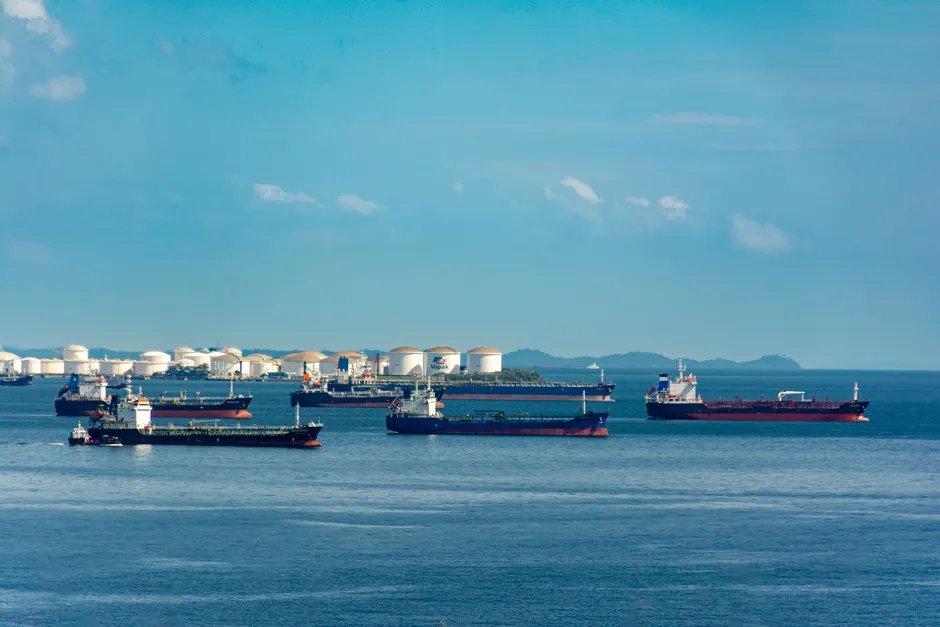
The Strait of Hormuz, a narrow waterway between Iran and Oman through which roughly a quarter of global seaborne oil normally passes, has become the conflict's chokepoint. A cargo ship was attacked while transiting the strait early on Tuesday, according to the UK Maritime Trade Operations agency. Ship tracking company Kpler recorded only six commodity ships passing through the Strait of Hormuz on Monday, up from five transits on Saturday and Sunday combined.
Deutsche Bank analysts wrote that rising oil prices reflected investors pricing in "a more extended closure" of the strait — meaning traders were betting the disruption would last longer, not just days. Dan Alamariu, chief geopolitical strategist at Alpine Macro, warned of a potential "double whammy" for energy prices if Middle East fighting continued alongside Russia's ongoing war in Ukraine. The price trajectory has tracked the conflict's intensity: Brent settled at $89.22 on 20 July, having hit $91.42 intraday, before falling below $90 and now returning to the low $90s (Reuters).
The diplomatic history leading to this moment is one of repeated false starts. A State Department spokesperson expressed "strong hope" for another ceasefire on 22 July 2025. By 12 August 2025, a State Department press briefing noted that Iran had made statements indicating it did not support the peace plan and that some Iranian officials said they would try to stop it. The G7 Foreign Ministers' meeting statement had earlier demanded that Iran cease and reverse its nuclear activities and immediately cease all support to Russia's war of aggression against Ukraine. The Iran Sanctions Act — a law authorizing economic penalties on Iran, such as restricting trade and freezing assets — was reauthorized through 31 December 2026 under the Iran Sanctions Extension Act (P.L. 114-277), maintaining the existing sanctions architecture that frames the economic pressure on Tehran.
The broader picture is that the convergence of the expired negotiation window, Trump's refusal to set a new deadline, and Iran's declared shift to a "fully offensive" posture leaves no identifiable diplomatic track in the immediate term. Oman's role as mediator has survived two direct threats from the US president, but the corridor it was mediating has not materialized. With Hormuz traffic at a trickle and Tehran issuing direct warnings to shipping, the market is now pricing not a temporary disruption but a sustained constriction of supply. Whether the IRGC backchannel Trump confirmed produces movement will depend on whether either side sees a cost in continued escalation that exceeds the cost of compromise. On the current trajectory, neither has signaled that threshold has been reached.