NASA's Roman Space Telescope: What It Will Do and Why It Matters
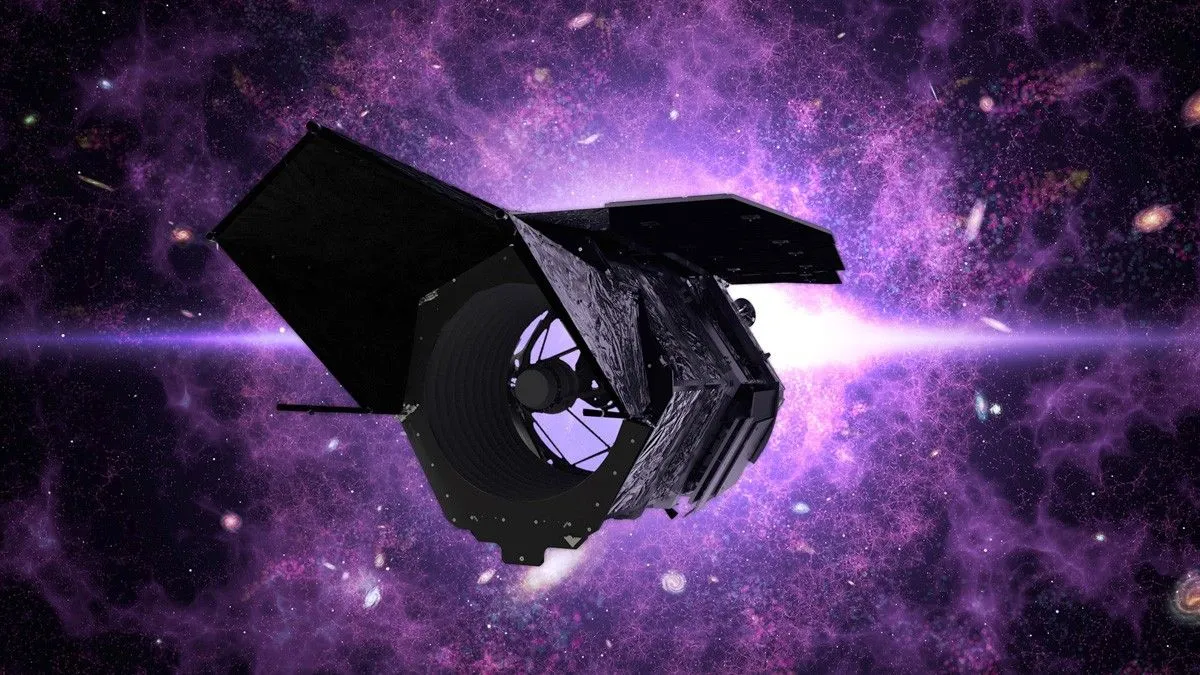
NASA's Nancy Grace Roman Space Telescope is set to launch from Kennedy Space Center's Launch Complex 39A in Florida at 7:26 a.m. ET on August 30, 2026, aboard a SpaceX Falcon Heavy rocket. The $4.3 billion observatory will travel to Lagrange point 2 (L2), a gravitationally stable spot in the sun-Earth system about one million miles from Earth. There, it will operate in the same orbital neighborhood as the James Webb Space Telescope, though the two will remain far apart. NASA expects the telescope's first images in early 2027, after months of calibration and testing in its final orbit.
The mission is built around three goals: investigating dark matter and dark energy, taking a statistical census of planetary systems in the Milky Way, and advancing infrared astrophysics. Its 300-megapixel infrared camera matches Hubble's sharpness and angular resolution (the ability to distinguish fine detail), but with a field of view at least 100 times larger. Think of it this way: if Hubble is a telephoto lens that captures a small patch of sky in exquisite detail, Roman is a wide-angle lens that captures the same level of detail across a much broader area. Each individual Roman image will cover a patch of sky roughly 1.5 times the apparent size of a full moon. Over its operational lifetime, the telescope could potentially measure light from a billion galaxies, according to NASA.
Roman also carries a coronagraph, an instrument designed to block out a star's light so that planets and the disks of dust and gas where planets form can be directly photographed. This technology demonstration could refine techniques for imaging exoplanets (planets around other stars), adding a new tool to the transit and radial-velocity methods that currently dominate exoplanet detection. The mission's initial five-year lifetime could be extended to ten.
The telescope is named for Nancy Grace Roman, NASA's first chief of astronomy, who is credited as the "mother of the Hubble Space Telescope" and who died in 2018. The project spent nearly a decade in development and survived two rounds of proposed White House budget cuts before reaching the launch pad. Julie McEnery serves as NASA's senior project scientist for the mission.
Roman's design philosophy sets it apart from Webb and Hubble. Rather than replacing either observatory, it is intended to support and extend their work. Hubble, launched in 1990, remains operational in low Earth orbit. Webb, launched in 2021, operates from L2 and specializes in high-sensitivity infrared spectroscopy and deep-field imaging. Roman's contribution is speed: where Hubble or Webb might image a narrow patch of sky over many orbits, Roman can capture equivalent resolution across vast swaths in a fraction of the time. All imagery will be made immediately public, a data-policy decision that could substantially increase the volume of open-access astronomical data available to researchers worldwide.
The broader context is that Roman arrives at a moment when NASA's flagship astrophysics portfolio is under fiscal pressure. The telescope survived White House budget-cut proposals twice, which suggests that cost pressures on NASA's science mission directorate are not abstract. Webb's own development history of delays and cost overruns created a political environment in which flagship missions face heightened scrutiny. Roman's launch is, in that sense, a data point about whether large-scale, multi-decade observatories can still survive the budget cycle to reach the pad.
For dark energy research, Roman's wide-field surveys could tighten constraints on the equation-of-state parameter (a measure describing how dark energy behaves over cosmic time) more effectively than ground-based programs. It would do this by measuring baryon acoustic oscillations (regular patterns in the distribution of galaxies) and Type Ia supernova distributions (the spread of a specific class of exploding stars used as distance markers) across large cosmological volumes. For exoplanet science, the mission's planned microlensing survey, which detects planets by watching how their gravity briefly magnifies the light of background stars, is expected to find cold, low-mass exoplanets at orbital distances where transit and radial-velocity surveys lose sensitivity. That could fill a gap in the galactic census of planetary architectures. The coronagraph technology demonstration, if successful, would advance the maturation of starlight-suppression hardware that future direct-imaging missions would require.
A public "activation" event was held at the Kennedy Space Center on August 28 and 29, ahead of the launch. NASA issued a news release on August 24 setting coverage plans for the launch from Florida.