The Venezuelan Doublet: Two Major Earthquakes and What They Mean for the Region

Two powerful earthquakes struck northwestern Venezuela on June 24, 2026, killing at least 164 people and injuring 971 others, according to acting President Delcy Rodríguez and AP News. The USGS classified the sequence as a doublet — two mainshocks of nearly equal strength that ruptured adjacent fault segments in quick succession — with magnitudes of 7.2 and 7.5, separated by just 39 seconds.
Both earthquakes centered southeast of Yumare in Yaracuy state at depths of 23 and 28 kilometers. The USGS attributed them to strike-slip faulting, where the South American and Caribbean tectonic plates grind horizontally past each other. This same plate boundary produced the devastating 1812 Caracas earthquake and a magnitude 7.7 earthquake in 1900 offshore. Strike-slip ruptures at these depths typically generate strong, widely-felt shaking across large distances, though they carry less tsunami risk than shallow undersea faults. Their destructive power in Venezuela stems from proximity to dense urban centers that efficiently convert seismic energy into casualties and structural failure.
Why this classification matters: a true doublet is seismologically unusual. When two comparable-magnitude earthquakes rupture neighboring fault segments within seconds, they effectively reset the stress field in ways that complicate standard aftershock predictions. Aftershock models rely on formulas calibrated for single mainshocks; the doublet compounds stress changes, making it harder to forecast where and how often secondary tremors will occur in the hours and days ahead.
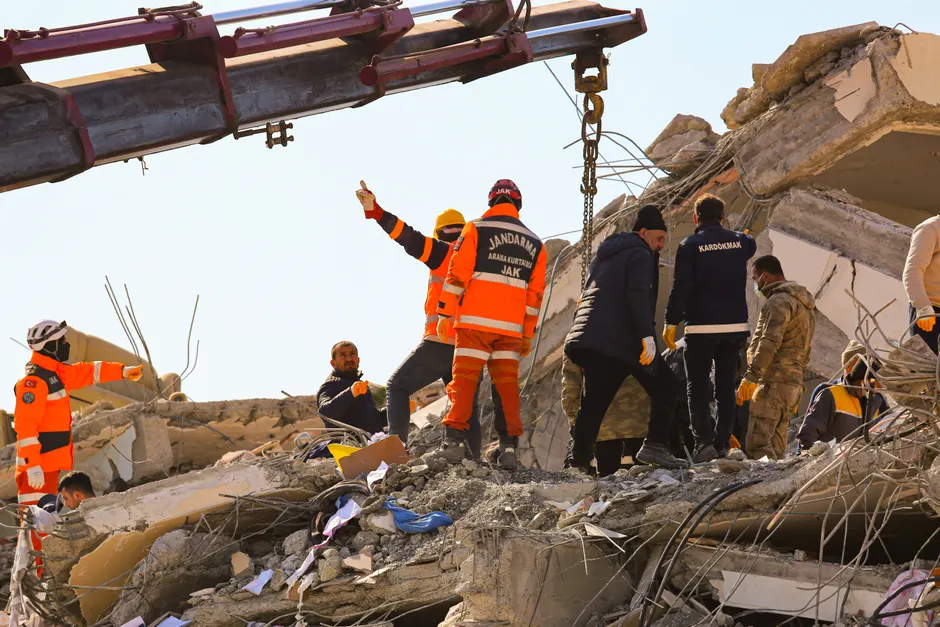
Buildings collapsed in Caracas, roughly 250 kilometers from the epicenter, revealing the long-wavelength energy typical of strike-slip ruptures. Caracas sits in a valley filled with sediment that amplifies shaking — a vulnerability documented in the 1967 Caracas earthquake, also magnitude 6.5. Engineering investigations will need to distinguish how much collapse resulted from informal and unreinforced masonry construction versus the amplifying effects of the valley's geology.
The death toll and injury count reported in the first 24 hours typically represent a floor. Search-and-rescue operations in collapsed structures routinely raise both figures over the next three days, and Venezuela's health system has operated under severe resource constraints for years. Power outages, communications failures, and limited hospital capacity will shape recovery as much as direct earthquake damage.
Acting President Rodríguez now leads the government response to what has been a politically contested period in Venezuelan governance. How Caracas handles incoming international aid — and whether the Maduro administration's frayed relationships with Western donors and regional partners slow relief logistics — will be instructive in the coming weeks. The sequence underscores a broader vulnerability: the Caribbean–South American plate boundary remains one of the Western Hemisphere's most hazardous tectonic zones, yet it remains under-monitored. Early warning networks and building code enforcement in Venezuelan cities lag significantly behind comparable urban centers elsewhere in earthquake-prone Latin America. Two magnitude-7+ earthquakes within a minute stress-test response systems built around the assumption of a single major event.