Two Major Earthquakes Strike Venezuela, Exposing Urban Seismic Risk

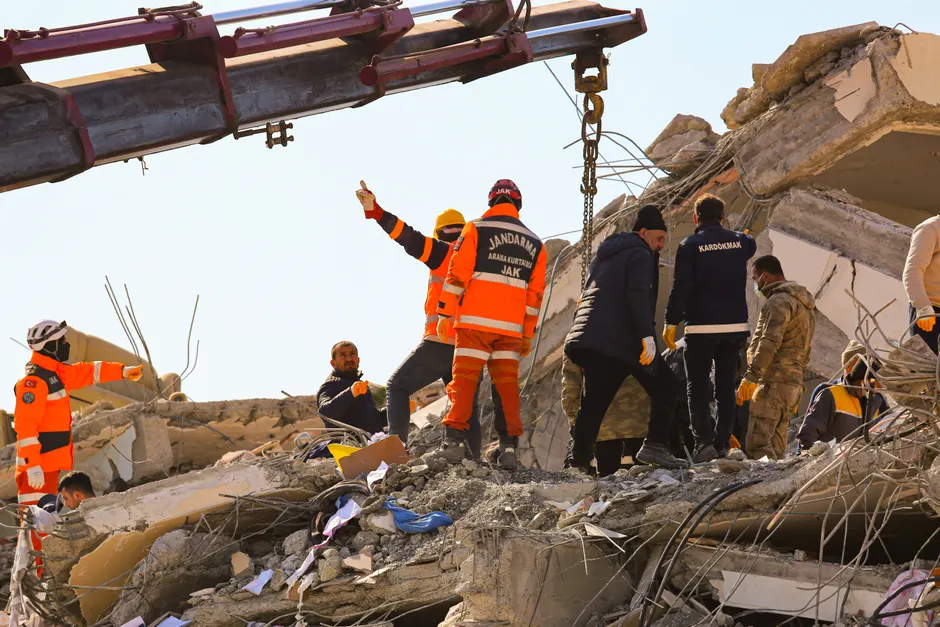
Two large strike-slip earthquakes hit northwestern and central Venezuela on June 24, 2026, killing at least 32 people and injuring roughly 700, according to Reuters. The stronger reached magnitude 7.5 and centered about 160 km west of Caracas; the second registered M7.2 in a similar zone. Both generated severe shaking that collapsed concrete-frame buildings across the capital.
The building collapses expose a structural vulnerability seismologists have documented for years. Venezuela's urban housing — much of it informally constructed reinforced concrete from the 1960s through the 1990s — was not designed to ductility standards that modern building codes require. Strike-slip events at shallow depths create short-period, high-frequency ground motion — rapid waves that columns and soft-story frames (floors with weak supports) cannot effectively absorb. The death toll of 32 reported by Reuters on June 25 is almost certainly provisional; secondary collapses, ongoing search-and-rescue, and hospital capacity will shift that number in the days ahead.
The Seismic Context
Venezuela sits on the right-lateral Caribbean–South American plate boundary — a zone where tectonic plates slide past each other horizontally across the country's northern region. Large earthquakes here are not routine by Pacific Rim standards, but they recur on timescales that matter for urban planning. The 1812 Caracas earthquake and the 1967 event (M6.5) both killed thousands and both revealed the same problem: dense informal construction on alluvial soils that magnify ground motion. The 2026 sequence arrived as two distinct mainshocks rather than one, which complicates aftershock forecasting and means already-damaged buildings face an extended window of elevated risk.
Other Global Earthquakes That Day
The Venezuela sequence was not alone. On June 24, a M5.6 earthquake struck 11 km north of Redwood Valley, California at 15:10:40 UTC at a depth of 8.1 km, per USGS data. The event drew 5,055 "Did You Feel It" responses — a volume reflecting the population density and felt-area footprint of a moderate shallow crustal event rather than any structural threat. Separately, a M7.2 event in the Ryukyu Arc region generated intensity 5 shaking on Japanese islands in Okinawa Prefecture. On the Japan Meteorological Agency scale, intensity 5 is where unsecured objects fall, heavy furniture shifts, and some unreinforced masonry sustains damage — serious but a magnitude tier below the Venezuela collapses in terms of urban impact.
A minor M2.3 event 53 km northeast of Encontrados, Venezuela — at 79.9 km depth, recorded at 04:03 UTC on June 24 — preceded the mainshocks and is being reviewed as part of the broader sequence.
The clustering of significant earthquakes across the Pacific and Caribbean in a single 24-hour window reflects the statistical baseline of a tectonically active planet. Yet the coincidence draws attention to a real gap: seismic risk management in high-exposure, lower-income urban environments remains one of the world's most consequential blind spots in disaster preparedness.
What Happens Next
For Venezuela, the humanitarian challenge is compounded by the country's pre-existing economic contraction and years of institutional erosion in its civil emergency services. Search-and-rescue operations in Caracas depend on equipment and coordination that institutional decay has strained. International offers of assistance — technical teams, field hospitals, structural engineers — will face the same logistical and political friction that has historically slowed foreign relief in Venezuela.
The Los Angeles Times has drawn explicit parallels between the Caracas collapses and California's own inventory of non-ductile concrete structures — a comparison grounded in seismic engineering. California has run a mandatory retrofit program for such buildings for over a decade, but tens of thousands of units remain unretrofitted. The Venezuela sequence is now evidence of what deferred action looks like when a large strike-slip earthquake strikes an unprepared city.
The death toll will change. The damage picture beyond Caracas is still being assessed. And the aftershock sequence — statistically elevated for weeks after bilateral M7+ ruptures — means the risk period extends beyond the initial shaking.