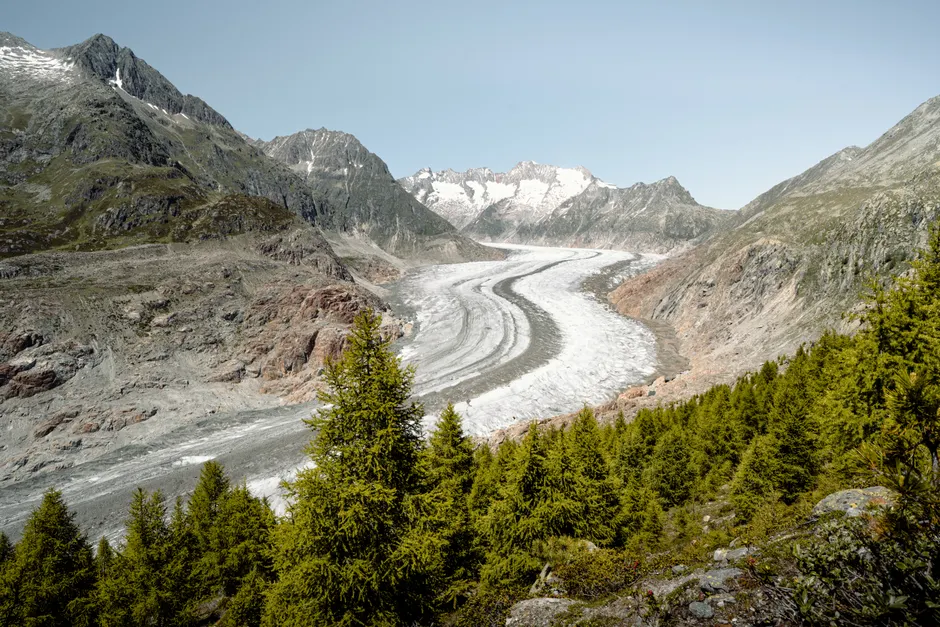
Swiss Glaciers Lost 5.5% of Their Ice in 2026

Swiss glaciers lost 5.5% of their ice volume in the first eight months of 2026, just below the record loss set in 2022. Total loss since 2021 now stands at 19.4%, according to the annual monitoring report. The Guardian
Why the melt was so fast
Most of the loss came during the summer melt period, called the ablation season. Mean ice thickness fell by between 2.5 metres and 4 metres on individual glaciers in 2026. MeteoSwiss analysis found the April-to-September half-year was the hottest and driest in Switzerland since records began in 1864. Limited winter snow was followed by steady melting all summer.
How scientists track the loss
The report is a collaboration between the Swiss Glacier Monitoring Network and the Swiss Commission for Cryosphere Observation. Matthias Huss, glaciologist at ETH Zürich, is lead author. Long-term records are coordinated through GLAMOS, Glacier Monitoring in Switzerland, which is jointly operated by ETH Zurich and the Universities of Fribourg and Zurich and works in close contact with the Swiss Commission for Cryosphere Observation. Its work is financially secured by support from the Federal Office for the Environment, MeteoSwiss under GCOS Switzerland, and the Swiss Academy of Sciences, with substantial support from the Federal Office of Topography swisstopo. GLAMOS
Direct measurements on the ice, called mass-balance observations, show how intense the season was. Like a bank balance, they compare snow added in winter with ice lost in summer. A monitoring site at the Rhone Glacier lost about 1.5 metres of ice during two weeks of extreme heat in summer 2026. Reuters The Plattalvafirn, also identified as the Griess glacier, has lost 99% of its area in 20 years.
Part of a longer trend
The 2026 figures follow several high-loss years. Swiss glaciers lost 10% of their overall volume in the two years to 2023. Switzerland's glaciers had their second-worst melt rate in 2023 after the record losses in 2022. Reuters About 100 glaciers vanished in Switzerland between 2016 and 2022, according to GLAMOS. Reuters
The broader context here is steady shrinkage year after year, not one bad summer alone. The question is no longer whether a single hot, dry half-year can be absorbed. It is how each loss year lowers the starting point for the next year. That puts attention on keeping stake measurements in the ice, surveys of total volume and consistent climate records going, and on whether monitoring can keep pace as fewer glaciers remain to measure and they break into smaller fragments.