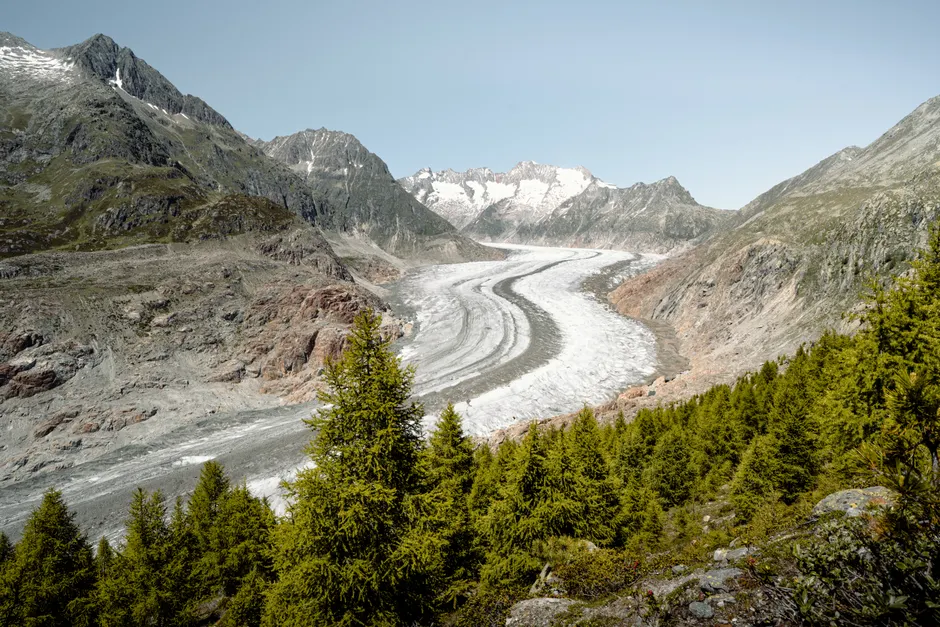
Swiss Glaciers Lost 5.5% of Their Ice in 2026

Swiss glaciers lost 5.5% of their ice volume in 2026 due to heat waves and low winter snowfall, according to data reported on Oct. 1. Associated Press
The loss was rapid. It ranks as the second-biggest annual loss of Swiss glacier volume on record. Deutsche Welle put the 2026 decline at more than 5%, while the more precise 5.5% figure provides the authoritative accounting for the year.
The 2026 melt followed a record-breaking European heatwave and counts as one of the worst years of ice loss for Switzerland. Reuters The volume lost in 2026 totaled 2,000 billion liters of water. Reuters
The five-year toll is now steep. In the five years ending in 2026, Swiss glaciers lost nearly 20% of their mass, or total ice stock. Deutsche Welle
Winter snow acts as a shield. In 2026, Switzerland's glaciers exhausted their snow reserves by 29 June, leaving bare ice exposed for the peak of the summer melt season. That early loss of protective snowpack was documented in a June assessment from ETH Zurich's Department of Civil, Environmental and Geomatic Engineering.
Systematic tracking comes from GLAMOS, the Swiss Glacier Monitoring Network that follows long-term glacier changes in the Swiss Alps. GLAMOS is jointly operated by ETH Zurich and the Universities of Fribourg and Zurich, and works in close contact with the Swiss Commission for Cryosphere Observation. Financial support comes from the Federal Office for the Environment, MeteoSwiss within GCOS Switzerland, and the Swiss Academy of Sciences, with significant support from the Federal Office of Topography swisstopo.
The 2026 result extends a run of poor mass-balance years, meaning years when melting outpaced new snow, rather than an isolated anomaly. In 2025, Switzerland had a winter with low snow depth combined with heat waves in June and August that contributed to enormous glacial melting. In 2024, Swiss glaciers melted at an above-average rate after a hot summer thawed abundant snowfall.
The trend is clear on individual glaciers. Switzerland's Gries Glacier could melt at its lower points within five years, based on assessments reported in September 2025, while complete disappearance will take about 40 to 50 years.
The broader context here is what sustained, compounding loss does to planning. When nearly one-fifth of mass disappears in five years, each hot summer starts from thinner ice and a smaller firn reservoir, the store of old packed snow. That reduces the system's ability to absorb the next warm spell. For experts working on water management, hazards, and Alpine infrastructure, the question becomes less about single-year extremes and more about shortened response times.
Looking at what this means for the record, the ordering of causes matters. Low winter buildup followed by early snowpack loss and long exposure of bare ice creates a multiplier. Heat alone melts ice. Heat after late-June snow loss melts darker, older ice for longer, without interruption. That sequence, repeated across 2025 and 2026 with shifts in timing, helps explain why annual losses stay elevated even when winter conditions differ from year to year.