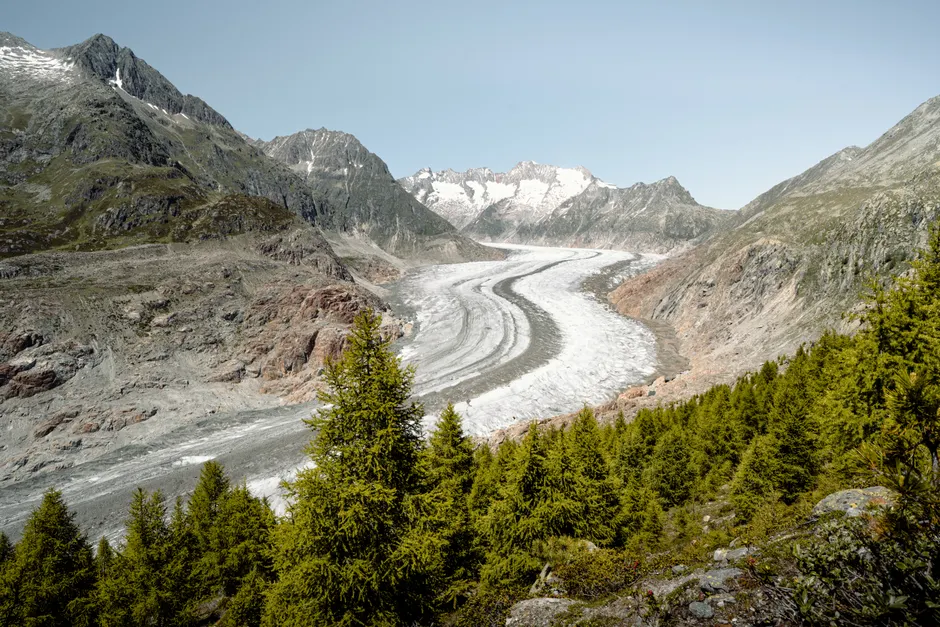
Swiss Glaciers Lost 5.5% of Their Ice in One Year

Swiss glaciers lost 5.5% of their ice volume in the hydrological year ending September 30, 2026. It is the second-largest annual loss on record, and it brings the total loss since 2021 to nearly 20%, according to researchers from the Swiss Glacier Monitoring Network (GLAMOS) and the Swiss Academy of Sciences (SCNAT) Al Jazeera.
A hydrological year runs from October to September, the cycle scientists use to compare winter buildup and summer melt. The findings were published in a joint report by GLAMOS and the Swiss Commission for Cryosphere Observation of SCNAT. SCNAT headlined its October 1 release as 'Swiss glaciers lose a further five per cent of their volume', while the detailed assessment put the 2026 loss at 5.5%. The 2026 loss ranks behind only the prior extremes of this five-year sequence DW.
Losses centered on the high-summer ablation period, the weeks when melting runs fastest. Between July and September 2026, Swiss glaciers lost about 2.2 trillion litres of water, or 581 billion gallons. That three-month flow is more than four times the annual drinking water use of all Swiss households. Mean ice thickness fell by 2.5 to 4 metres across individual glaciers during 2026. At glacier tongues, the low and thin extensions at the bottom, thickness dropped by as much as 10 metres in places over the summer.
The estimate rests on late-season fieldwork. In September, a GLAMOS team visited 23 glaciers to record end-of-summer ice melt and snow buildup. Those stake readings, snow-pit checks and thickness tests anchor the calculation of national volume change for the year ending September 30.
GLAMOS is the Swiss Glacier Monitoring Network, also called Glacier Monitoring in Switzerland. It is run jointly by ETH Zurich and the Universities of Fribourg and Zurich, and it tracks long-term glacier change in the Swiss Alps. Its work is funded by the Federal Office for the Environment (BAFU), MeteoSwiss within GCOS Switzerland, and SCNAT, with substantial support from the Federal Office of Topography swisstopo. It works in close contact with the Swiss Commission for Cryosphere Observation.
The drivers came in sequence. The loss followed a winter with little snow, which limited seasonal buildup ETH Zurich. Summer 2026 was the hottest summer on record in Switzerland, according to GLAMOS chief Matthias Huss, a glaciologist at ETH Zurich. SCNAT reported that from 29 June onward the glaciers had exhausted their snow reserves, so every litre of meltwater caused net loss.
Huss called 2026 "a catastrophic year" for Swiss glaciers Yahoo. Thin winter cover left little protection. Record summer heat then stripped it early and exposed bare ice for a long stretch.
The broader context here is compounding loss rather than one odd season. Mass balance is the difference between snow gained and ice lost, and five straight years of large deficits reset the baseline for each new year. Thinner glaciers with less firn, or old compacted snow, have less cushion against a hot summer, and tongue losses of the size seen in 2026 change glacier shape in ways field teams track year to year.
Looking at what this means for monitoring and policy, the value of the September campaign is continuity. Twenty-three glaciers measured with the same methods allow direct comparison across extreme years. For water management, energy planning and hazard assessment in the Alps, the test is less whether one hot summer can be absorbed than how low-snow winters and hot summers combine. The next winter buildup season will determine how much of the 2026 thinning carries into the 2027 budget.