European Gas Went From 30 to 80 Euros: The LNG Squeeze Explained

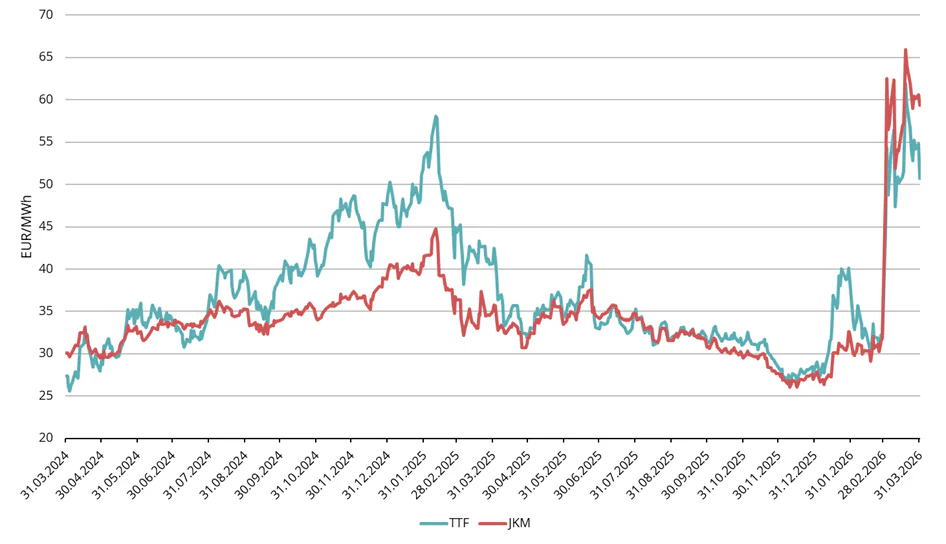
Europe's benchmark gas price jumped from about 30 euros to 80 euros per megawatt-hour to hit its highest level since early 2023, as attacks in the Middle East disrupted shipments of liquefied natural gas.
That benchmark is the Dutch Title Transfer Facility, or TTF, the market most of Europe uses to trade gas. A megawatt-hour is a unit of energy. LNG is gas chilled to liquid so it can be carried by ship, then turned back to gas on arrival.
The scale was laid out on September 17, 2026, when the benchmark was quoted at 80 euros after starting the move near 30 euros, according to Reuters. That matched the assessment on September 9, 2026 that European prices had hit their highest since early 2023 on a prolonged LNG squeeze, according to the Wall Street Journal. The TradingEconomics print for October 8, 2026 was 79.60 EUR/MWh, up 1.95% from the previous day.
The shock began in March. European natural gas prices surged 38.9% on a Tuesday after an Iranian strike halted production at Qatar's Ras Laffan LNG facility, according to the Wall Street Journal. Dutch TTF rose to 74 euros/MWh in March 2026 before easing to hover around 50 euros/MWh in May 2026.
Prices rose again into late summer. The Dutch TTF contract for October 2026 delivery reached an intraday high of 70.85 euros per megawatt-hour on Monday, August 31, 2026, according to ICE data. Prices then climbed more than 2% to trade just below 74 euros per megawatt-hour on LNG supply concerns ahead of winter. That September 7 level came before the run toward 80 euros.
Hormuz exposure and crude divergence
Ship attacks in the Strait of Hormuz surged in early October 2026, according to Al Jazeera and Reuters shipping reporting. About 20% of the world's liquefied natural gas supply moved through the Strait of Hormuz in 2025.
Middle East crude oil exports exceeded pre-war levels for about half of September 2026, according to shipping data reported on October 5, 2026, according to Reuters. That report paired higher loadings with an increase in tanker attacks.
The broader context here is the split between crude and gas through the same corridor. Physical crude kept clearing. Risk was priced more aggressively in European gas and in tanker security. For gas, the Hormuz link runs through LNG. The Ras Laffan outage showed how fast Atlantic pricing must replace Gulf cargoes. Europe then bids against Asia for flexible ships, and TTF becomes the price that diverts them.
Freight and winter positioning
Strong European demand for liquefied natural gas was expected to cap LNG shipping costs in winter 2026 by keeping more cargoes within the Atlantic, as reported on October 7, 2026, according to Reuters. A growing fleet size was also cited as pressure on winter shipping rates in that October 7 assessment.
The mechanism is geographic. If European buying holds Atlantic cargoes in-basin, laden voyages shorten and vessel availability improves. That can dampen spot charter rates even while commodity prices stay elevated. More hulls plus shorter Atlantic trips would increase the effective supply of shipping.
The broader context for winter is duration, not just disruption. The March to May pattern, 74 euros down to 50 euros, looked like a short outage that storage and lower demand could absorb. The August to September pattern, 70.85 euros intraday to just below 74 euros to 80 euros, looks like tightening into heating season. Storage injections, Norwegian flows and US loadings matter at the margin, but verified facts point to Gulf LNG availability as the swing variable.
In my view, the freight signal will be the tell for winter. If Atlantic retention caps shipping costs as expected, it confirms Europe is pulling cargoes by paying up at TTF. If freight spikes despite fleet growth, it would point to longer diversions around risk zones or competition for carriers to move replacement volumes over greater distances. Either path leaves TTF exposed until Gulf LNG reliability is restored.